What this article is not
The internet is full of “top 10 best water filters” lists ranked by affiliate commission. We are not doing that here. A brief explanation of what this guide is and is not.
What it is not: a ranking based on popularity, a list selected on highest commission, a review based on our own lab tests, or sponsored content.
What it is: an evidence-based guide based on (a) European certification valid in the Netherlands, (b) independent scientific literature on filter technologies, and (c) independent laboratory tests where available.
Affiliate disclosure: some links in this article are affiliate links via the Bol.com Partner Programme and Daisycon (waterfilterexpert.nl). When you purchase a product via these links, we receive a small commission at no extra cost to you. These commissions do not influence our editorial choices. We name products based on performance and certification, not on commission percentage. Read our affiliate disclaimer for more details.
First this: what is in your tap water?
Before we talk about filters, the question you probably want answered first: do you actually need a filter?
Dutch tap water belongs to the most strictly controlled drinking water systems in the world and meets the European Drinking Water Directive. For most Dutch households, the water contains traces of:
- Chlorine: from the purification process. Not unhealthy, but often noticeable in taste and smell.
- Limescale (calcium and magnesium): not harmful to health. To a certain extent these minerals are actually desirable, giving water its characteristic taste and contributing to daily mineral intake. The opposite, water that is too soft, tastes flat and can be more aggressive on plumbing. The problem is usually the reverse: hard water that leaves deposits on appliances and showerheads. For those who get enough calcium and magnesium through diet (practically everyone with a normal Western diet), the minimal loss through a filter is no problem.
- Pharmaceutical residues and PFAS: in low concentrations, nanograms to low micrograms per liter. Whether filtering is worthwhile is the question this guide primarily addresses.
- Lead: only in older homes (before 1960) that may still have lead internal plumbing, or in a small number of cases through unreplaced service lines between the street and the home. More on this below.
- Microplastics: in low concentrations, research is still in its early stages.
An important distinction: in western Netherlands drinking water mostly comes from surface water (the Rhine, the Meuse and Lake IJsselmeer), resulting in slightly higher concentrations of pharmaceutical residues and PFAS. In eastern, northern and parts of southern Netherlands drinking water mainly comes from groundwater, generally with lower concentrations of chemical contaminants but with potential other challenges (higher nitrate, higher iron levels). Similar regional differences exist across most European countries with mixed water sources.
For those seeking depth: our articles on PFAS in Dutch tap water 2026, pharmaceutical residues in tap water 2026 and microplastics in tap water and bottled water provide the detailed context. For those wanting to know how the water reaches your glass and what happens to it afterwards, our articles on Dutch drinking water treatment and how water boards treat wastewater provide background.
Which contaminant takes priority for you determines which filter you need. Not the other way around. Buying a filter “because it seems necessary nowadays” without knowing why is rarely the wisest choice.
How filters work
Before we move to specific products, an honest explanation of how the different filter technologies work, so you know what you are buying.
Sediment filter
A sediment filter is a mechanical pre-filter that removes suspended particles from water: sand, rust, dislodged pipe fragments and coarser debris. Works through simple sieve action, with pore sizes typically varying between 50 and 1 micron. Drinking water companies already use similar sand filtration early in the purification process, so visible sediment is rarely present in your tap water. For household use, a sediment filter is mainly applied as the first stage in a multi-stage system (for example before a reverse osmosis installation), to protect the subsequent finer filters against premature saturation. Does not remove chemicals, limescale, or bacteria.
Activated carbon filter (GAC and Carbon Block)
Activated carbon filters are by far the most commonly sold category. They work via adsorption: organic molecules, chlorine and some other substances stick to the enormous internal surface area of the carbon material. There are two subtypes that differ fundamentally in performance:
- GAC (Granular Activated Carbon): loose carbon granules. Short contact time, lower performance. Good against chlorine, limited against more complex contaminants.
- Carbon block: compressed carbon granules in a solid block. Longer contact time, finer pore size, much better performance. A well-engineered carbon block can remove up to 95% of PFAS.
Activated carbon filters are effective against chlorine, taste and odor, some pharmaceutical residues and (in carbon block form) PFAS. Not effective against limescale, minerals, or heavy metals without specific claims.
Reverse osmosis (RO)
An RO system forces water under pressure through a semi-permeable membrane with pores so fine that even dissolved molecules cannot pass through. A good RO system removes 95-99% of practically all contaminants: PFAS, pharmaceutical residues, lead, microplastics, heavy metals and even a large portion of minerals.
Two important caveats: first, classic RO consumes more water than it filters, typically 3-4 liters of waste per liter filtered, although modern systems bring this down to 1:1 or better. Second, it also removes beneficial minerals, which some systems compensate for with a remineralization stage that adds calcium and magnesium to restore taste and mineral balance.
Ion exchanger (resin filter)
An ion exchanger works on a chemical principle worth explaining. The resin in the filter consists of plastic beads with a permanent negative charge, on which sodium ions (Na⁺) are attached in the starting state. When hard water flows through the resin, an exchange takes place: calcium and magnesium ions (Ca²⁺ and Mg²⁺) from the water have a stronger positive charge than sodium. They displace the sodium ions on the resin beads, remain there themselves, and the sodium is released into the water.
The end result: your water no longer contains limescale, but contains sodium in place of calcium and magnesium. For most people this is no problem because the amount is modest. For those on a low-sodium diet (for example with high blood pressure or heart failure) it is worth considering. For this group, alternative systems exist that use potassium chloride instead of sodium chloride.
Every few days the saturated resin must be regenerated. This happens by leading a concentrated salt solution (brine, sodium chloride in water) through the resin. The very high sodium concentration now pushes the exchange the other way: the sodium displaces the calcium and magnesium from the resin. The released Ca²⁺ and Mg²⁺ combine with the chloride ions (Cl⁻) to form calcium chloride and magnesium chloride. These are flushed away through the sewer together with the excess brine.
The two most common household applications:
- Water softener: the sodium-cycle process described above. Designed for limescale removal.
- Demineralizer: replaces both positive and negative ions, delivers ultra-pure water. For industrial applications.
Effective against limescale and some heavy metals. Not effective against organic contaminants such as PFAS, pharmaceutical residues or chlorine. An ion exchanger solves a different type of problem than activated carbon or RO. A separate article on water softeners will follow later on this site.
Gravity-fed system (ceramic with clay)
Here water is led through fine-porous ceramic or clay elements, often combined with activated carbon and colloidal silver. Well-known brands: Berkey, Doulton, and the more recent Ecofiltro from Guatemala.
The fine pores (typically 0.2-0.9 micron) hold back bacteria, parasites and microplastics. The activated carbon handles removal of organic contaminants. The colloidal silver inhibits bacterial growth in the filter itself.
Main advantages: no electricity needed, no plumbing connection, freestanding on the countertop. Main disadvantage: slow filtration (typically 1-2 liters per hour), meaning you have to build up a reserve.
UV filter: important nuance
Ultraviolet light (specifically UV-C, with a wavelength around 254 nanometers) kills living organisms (bacteria, viruses, parasites) by damaging their DNA. It does not remove chemical contaminants. PFAS, pharmaceutical residues, lead and even chlorine remain unaffected.
Important caveat: a UV filter kills micro-organisms, but does not remove them from the water. The dead bacteria remain in the water stream, together with their cell remains. For most purposes this is no problem, because dead bacteria cannot cause infection. But for those who want water that is also visually and chemically completely clean, UV must always be combined with a mechanical or chemical filter that subsequently removes the organic remains.
For regular Dutch tap water a UV filter is unnecessary: the wastewater treatment plants and residual chlorine already do this work. UV filters are useful as an addition in specific situations: well water, rainwater storage systems, or places where water stands for longer periods in a tank after pre-filtration. Additionally, UV can contribute to keeping plumbing clean and combating biofilm formation at specific points in the system (especially relevant in old or poorly maintained internal installations, or for immuno-compromised users where pathogens like Legionella and mycobacteria pose a risk). Scientific research at Clemson University and the American Water Research Foundation shows that UV-C can effectively inhibit biofilm formation, with the caveat that this effect is local and does not extend beyond the filter point.
Boiling
The simplest alternative: three minutes of boiling kills practically all bacteria and parasites, including stubborn species like giardia and cryptosporidium. Important limitations: boiling kills micro-organisms but does not remove them from the water. The dead remains stay behind, as with a UV filter. Additionally, boiling does not remove chemicals (PFAS, pharmaceutical residues, lead remain, chlorine partly evaporates) and actually concentrates limescale and minerals through evaporation.
For Dutch situations boiling is usually unnecessary, but not as rare as you might think. Drinking water companies regularly issue boil advisories during localized contaminations. For example, Vitens (one of the largest Dutch drinking water companies) issued two boil advisories in the Amersfoort region in late December 2025 and early January 2026, lasting a total of over two weeks, with 85,000 affected households at the peak. The cause: enterococcus bacteria that probably reached the drinking water through aged concrete in a storage cellar from rainwater. During such a boil advisory, the advice is to boil tap water for three minutes before drinking, cooking, or brushing teeth. Bringing water to a boil is not enough: three minutes of actual boiling is needed to inactivate all bacteria.
Boil advisories typically arise from leaks, work on the pipe network, or failing infrastructure, and usually last from several days to about two weeks. Those who depend on their own water filter should know that a carbon filter or pitcher filter does not hold back the bacteria that cause a boil advisory: for microbiological safety, only RO, UV, or boiling are truly effective. A gravity-fed system with fine ceramic pores (Doulton, Berkey, Ecofiltro) does work.
Our best-tested filters
Compare all →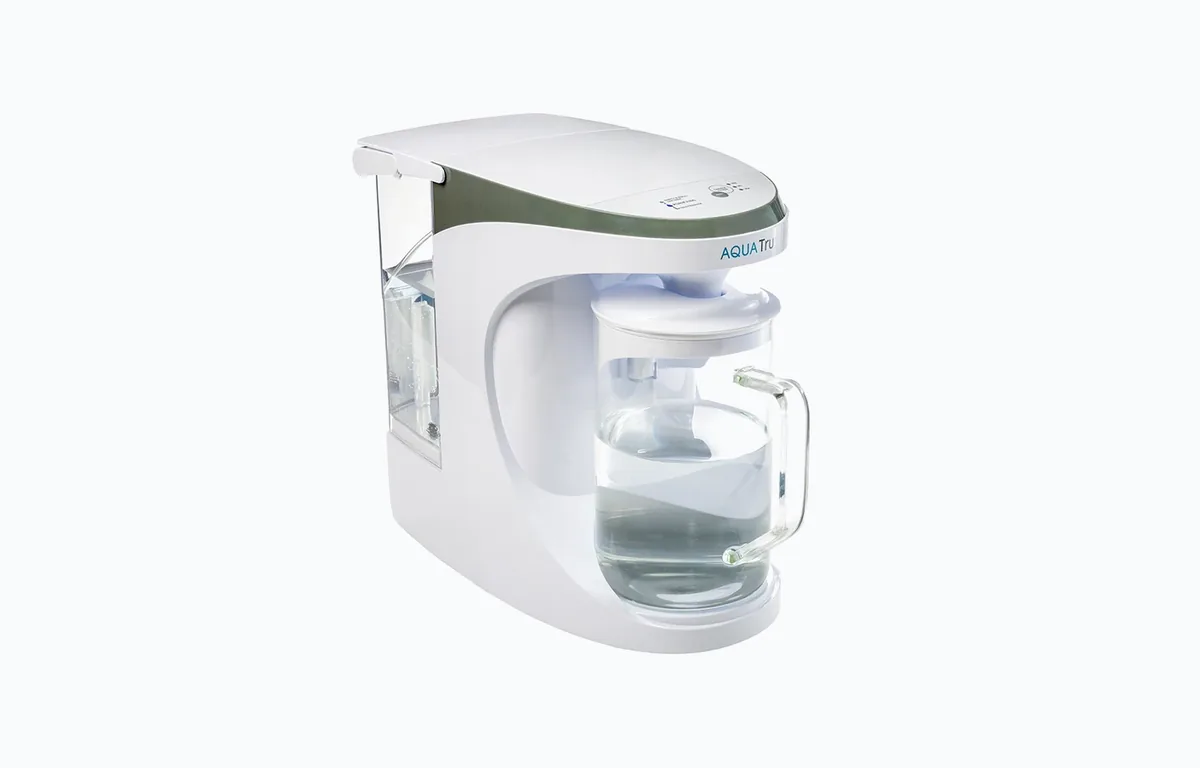
Compact countertop RO in carafe form for 1-2 people, same certification as the Classic.
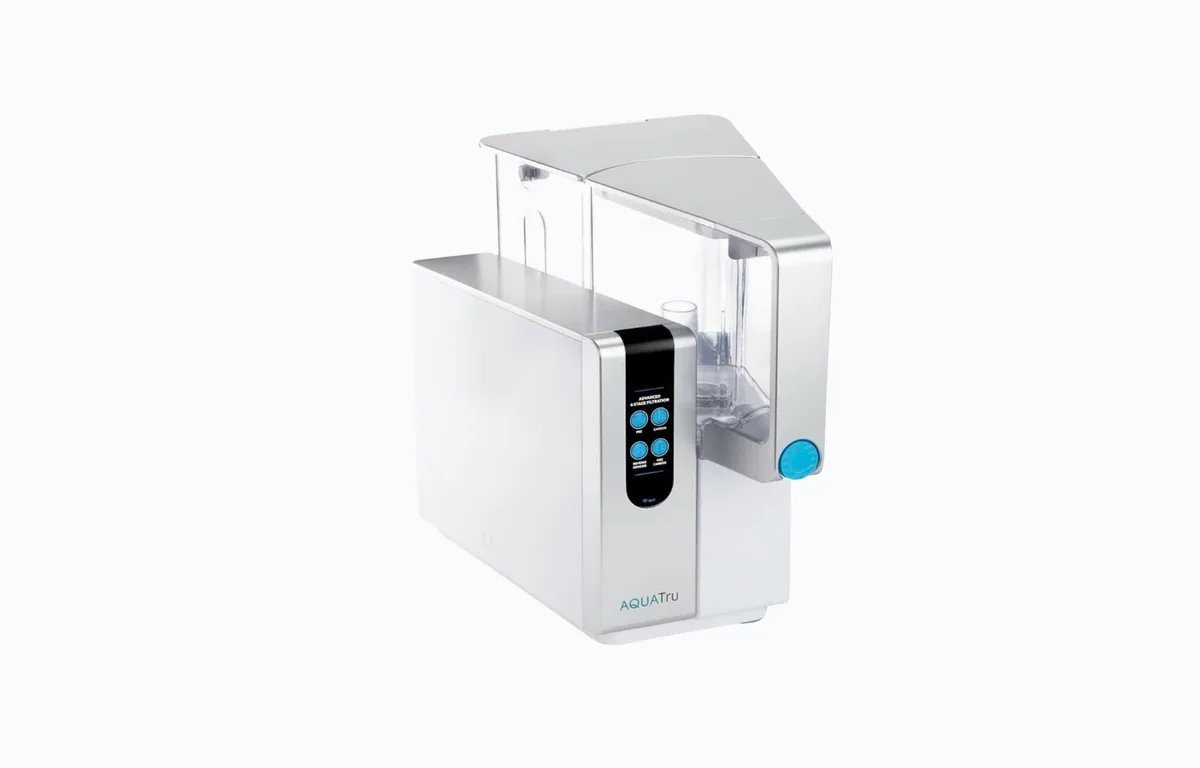
Countertop reverse-osmosis system requiring no installation, independently certified for 84 contaminants.
Compact 4.5 L variant of the certified British Berkefeld for 1-2 people.
Stainless-steel gravity filter with NSF 401-certified Ultra Sterasyl ceramic element -- the certified Berkey alternative.
Which filter works against which problem?
This is the heart of this guide. Per common concern we tell you which filter technology demonstrably works, and which does not, with concrete product examples where relevant.
PFAS and “forever chemicals”
PFAS are difficult to remove due to their chemical stability. Not all filters are designed for this.
Works well (>90% removal):
- RO systems with a good membrane
- Carbon block specifically engineered for PFAS (certified to NSF/ANSI 53, the American standard for specific contaminant removal, for PFOA and PFOS, the two best-studied PFAS compounds)
- Clay-ceramic system with activated carbon: Ecofiltro is independently tested by Measurlabs at >99% PFAS removal
Moderate: standard GAC without PFAS claim, works somewhat but performance is variable.
Poor: UV, sediment, simple pitcher filters without specific PFAS claim.
For shorter-chain PFAS (such as TFA, or trifluoroacetic acid, increasingly being detected in rainwater and groundwater), the filtering picture is even more challenging. RO gives the most reliable removal here.
Certified against PFAS
Compare all →
Compact countertop RO in carafe form for 1-2 people, same certification as the Classic.
Countertop reverse-osmosis system requiring no installation, independently certified for 84 contaminants.
Compact 4.5 L variant of the certified British Berkefeld for 1-2 people.
Stainless-steel gravity filter with NSF 401-certified Ultra Sterasyl ceramic element -- the certified Berkey alternative.
More background on PFAS in Dutch drinking water: see our article PFAS in Dutch tap water 2026.
Pharmaceutical residues and hormone residuals
Similar filter profile to PFAS. Both require fine filtration and long contact time.
Works well: RO systems, high-quality carbon block with sufficient contact time, clay-ceramic with activated carbon. Ecofiltro is lab-tested at >99% removal of pharmaceutical residues.
Moderate: GAC, with removal between 50-90% depending on the substance. Hydrophilic substances (water-soluble) pass through more easily than hydrophobic ones.
Poor: simple pitcher filters with short contact time, UV, sediment filters.
Particularly difficult are substances like carbamazepine (anti-epileptic) and X-ray contrast agents, very poorly biodegradable and hard to filter. RO is most reliable here.
The filters listed above under PFAS (the AquaTru systems and British Berkefeld) also remove pharmaceutical residues with certification. Ecofiltro has been independently tested by Measurlabs at over 90% removal of pharmaceutical residues. See the full list in our water filter comparison.
More context: see our article pharmaceutical residues in drinking water 2026.
Limescale (hard water)
Limescale is not a health problem but rather an aesthetic and appliance-damage problem. For those who only want to tackle limescale, a specific approach is needed.
Works well: ion exchanger (water softener), specific anti-limescale filters that either use ion exchange or silicopolyphosphate to inhibit crystal formation.
Moderate: silicopolyphosphate systems work preventively (prevent buildup) but do not remove limescale from the water. Some situations benefit, others do not.
Poor for this purpose: activated carbon does virtually nothing against limescale. RO works technically but is overkill if limescale is your only problem and unnecessarily wastes water.
Recommended route: for those who only want to tackle limescale at the house level (not primarily seeking drinking water filtration), a separate softener is better than a combination filter. We will write a separate article on water softeners and anti-limescale systems soon.
For those who want to tackle both limescale and chemical contaminants: a whole-house filter with anti-limescale (such as Alapure offers) supplemented with point-of-use RO for drinking water is the most complete solution.
Chlorine (taste and odor)
Chlorine is one of the easiest contaminants to filter, it adsorbs efficiently to activated carbon.
Works well: practically all activated carbon filters (GAC already works, carbon block better), RO, clay-ceramic.
Recommended route: for those who just want better-tasting tap water, a simple carbon system is enough. No RO needed, no advanced technology. A certified pitcher filter such as the BWT Vida water filter jug with magnesium filters or the simpler Brita models deliver fine results.
Lead and heavy metals
For those living in older homes (before 1960) where lead internal plumbing may still be present, lead removal is a serious consideration. Beyond that, a nuance many people do not know: the drinking water companies (Vitens, Waternet, PWN, Dunea and others) have made their main networks completely lead-free, but in a small number of cases lead remains in the service line (the pipe between the street and your water meter). In the Amsterdam-Amstelland region these have all been replaced, but in other municipalities such as Utrecht and Soest some situations remain where the service line could not be replaced (for example because residents did not give consent, or because the lines were inaccessible). This means that residents of newer homes can also occasionally receive lead traces in their water via an old service line, though this is rare.
An important development: as of January 1, 2025, the Netherlands has a replacement obligation for lead internal plumbing in rental properties. Landlords who do not comply risk fines, liability and possibly rent reduction. For those who own an older home themselves: the responsibility to replace lead internal plumbing lies with you. A 2020 NOS investigation showed that 165 Dutch municipalities did not know where lead pipes were still located, so actively researching this is worthwhile for older properties.
Works well: RO (practically all metals), NSF/ANSI 53 certified carbon block filters specifically for lead, clay-ceramic with activated carbon (Ecofiltro claims 82% reduction of lead and aluminum).
Poor: standard carbon filters without lead claim, pitcher filters without specific certification.
Lead removal requires specific certification. Not all carbon filters claim this, and a general “removes metals” claim is no guarantee. NSF/ANSI 53 for lead is the certification to look for.
For those who want to know if their home has lead pipes: most municipalities and drinking water companies offer free testing or home visits. A lead pipe is recognizable by its dull gray appearance, irregular shape, and a dull sound when tapped with a metal object.
Recommended products: the same independently certified filters as for PFAS also remove lead demonstrably. The AquaTru countertop RO and the British Berkefeld gravity systems are NSF/ANSI 53-certified for lead. Ecofiltro is a plastic-free gravity-fed alternative (independently lab-tested, lead as a manufacturer claim). See them in our comparison.
Microplastics
A relatively recently recognized problem. Research is still in its early stages, and few filters specifically claim this with certification.
Works well: all filters with pore size ≤1 micron, RO systems, high-quality carbon block, clay-ceramic systems. Ecofiltro has been independently tested at 100% removal of polystyrene microplastics, and itself releases no microplastics.
Poor: standard sediment filters (too coarse), simple pitcher filters.
Recommended products: Ecofiltro 5L and Doulton Filtadapt are independently verified for microplastics; the certified RO systems (AquaTru) remove them as well. See the options in our comparison.
More context on microplastics in Dutch tap water and bottled water: see our article microplastics in tap water and bottled water.
Bacteria and parasites
Not relevant for regular Dutch tap water: the wastewater treatment and any residual chlorine already do this work. Dutch drinking water is microbiologically very safe.
For those using well water, collecting rainwater, or preparing for emergencies:
Works well: ceramic filters (Doulton, Berkey, Ecofiltro with colloidal silver), UV, RO. Boiling as a simple backup.
Recommended products: the British Berkefeld (certified Ultra Sterasyl element), Doulton Filtadapt and Ecofiltro 5L. Note: the better-known Big Berkey system has no independent certification and variable EU availability; the British Berkefeld is the certified counterpart with the same ease of use.
Per situation: which type suits your household?
The previous section covered what works against which problem. This section covers what fits your living situation. Four household profiles with top recommendations.
Profile A: Single person or couple in a rental apartment
Characteristics: limited space, installation must remain simple, no plumbing modifications possible, generally lower budget.
Best choices without installation
Compare all →
Compact countertop RO in carafe form for 1-2 people, same certification as the Classic.
Countertop reverse-osmosis system requiring no installation, independently certified for 84 contaminants.
Compact 4.5 L variant of the certified British Berkefeld for 1-2 people.
Stainless-steel gravity filter with NSF 401-certified Ultra Sterasyl ceramic element -- the certified Berkey alternative.
Profile B: Family in an owned home (3-5 people)
Characteristics: enough water consumption to justify RO investment, under-sink installation usually possible, higher budget.
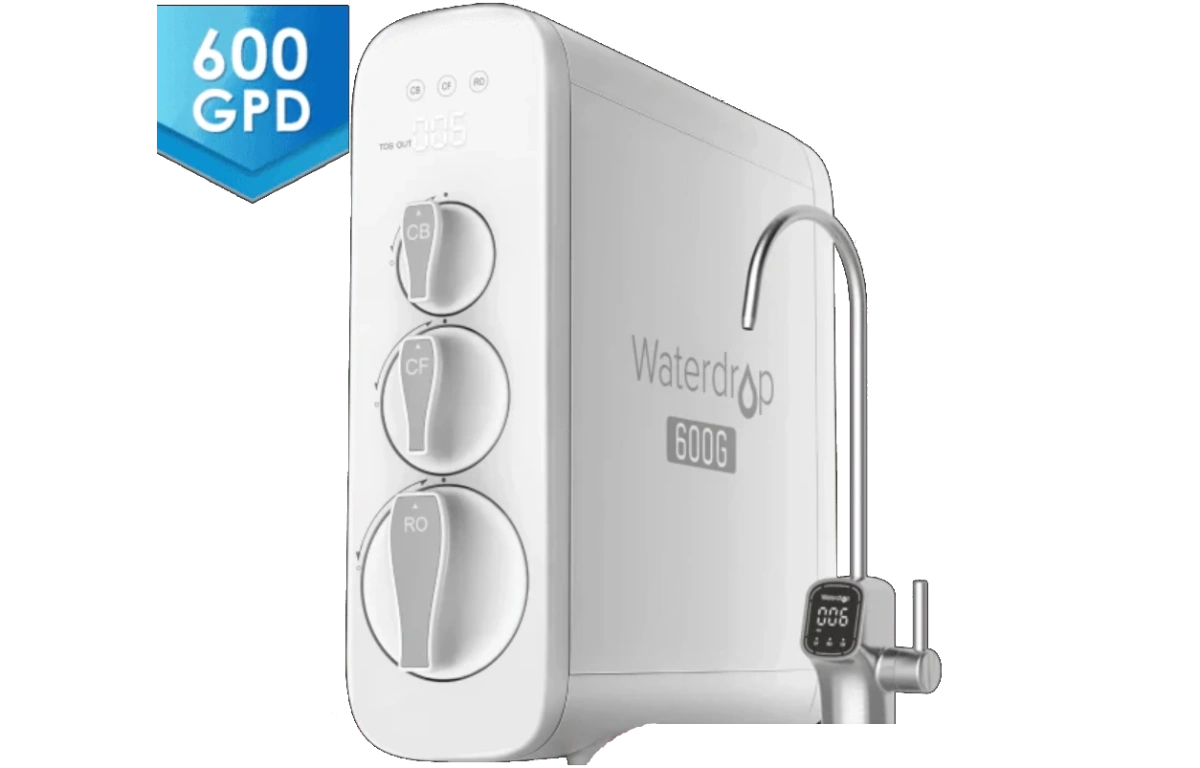
Tankless under-sink RO with 2270 L/day capacity, 8-stage filtration.
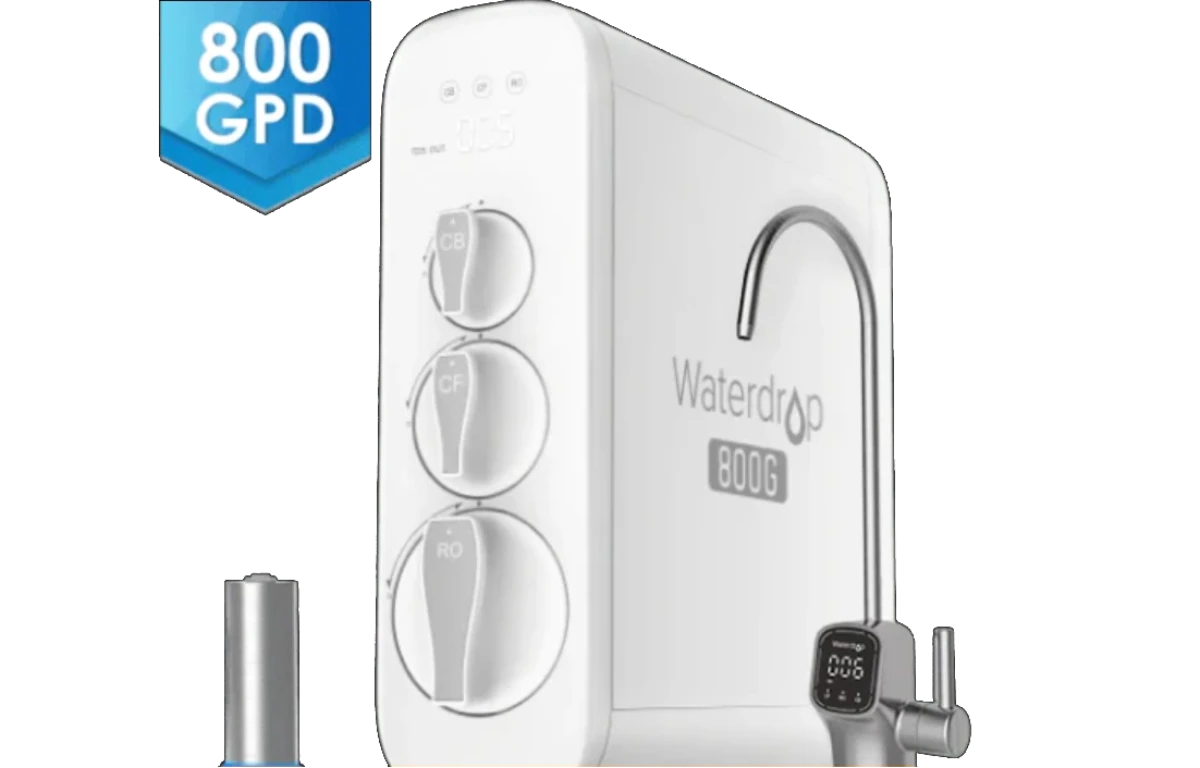
Tankless under-sink RO with high capacity (3000 L/day) and a favourable 3:1 water ratio.
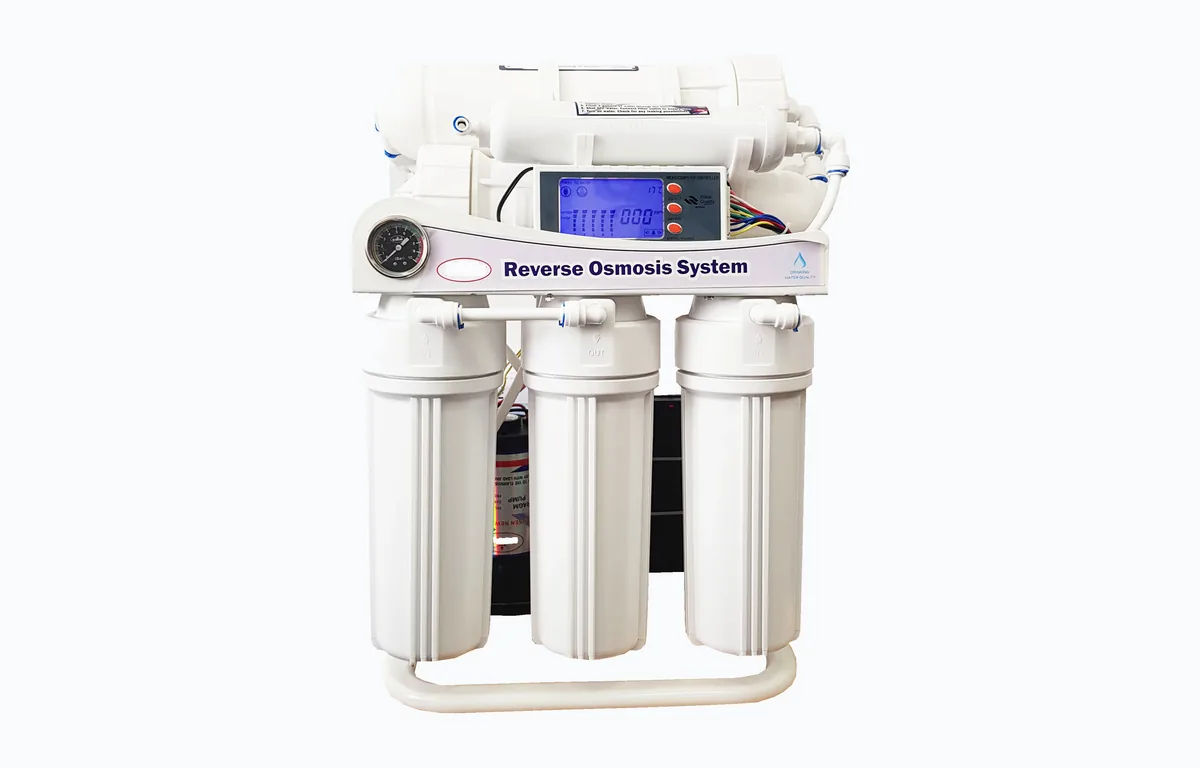
Tankless direct-flow RO with LCD display and pressure pump, high capacity, via a Dutch supplier.
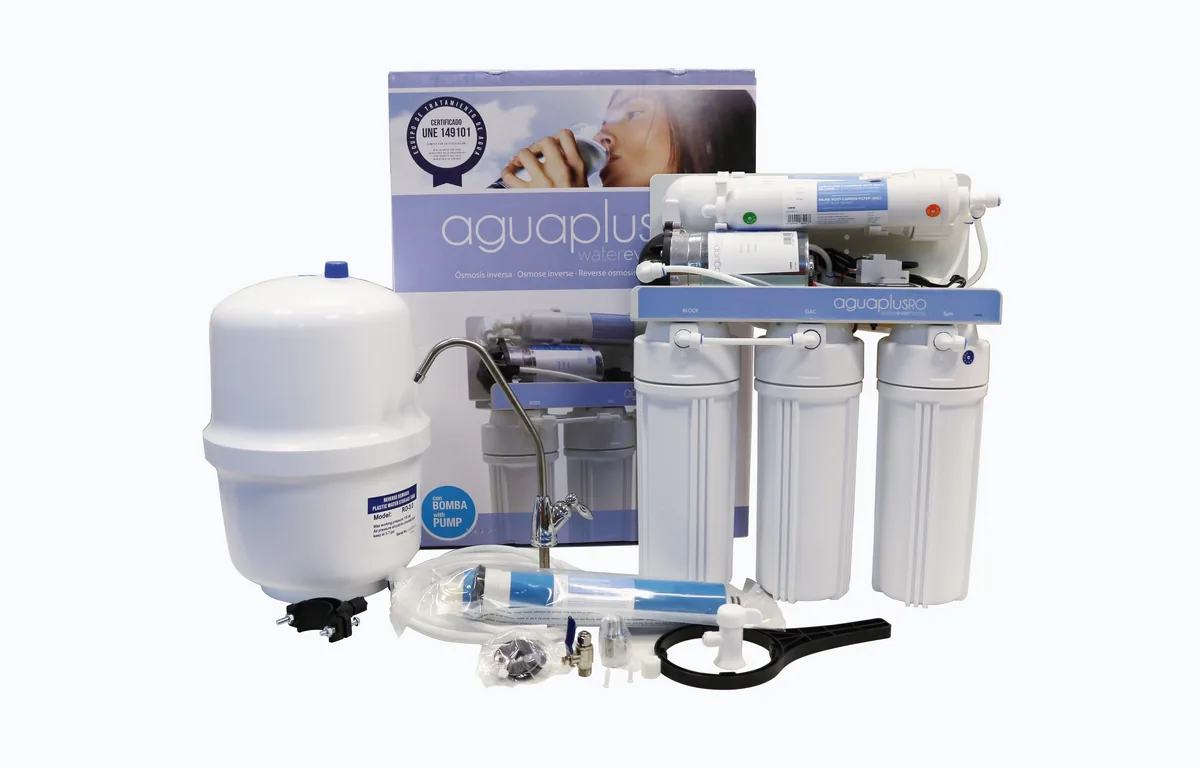
Under-sink RO with pressure pump and storage tank, via a Dutch supplier.
Profile C: Large household or multiple generations (5+ people)
Characteristics: very high water consumption, often also elderly or young children (more sensitive groups for PFAS and pharmaceutical residues), whole-house filtering becomes economically viable.
Top route: a layered approach with whole-house filter for limescale and baseline filtration, plus point-of-use RO for drinking water.
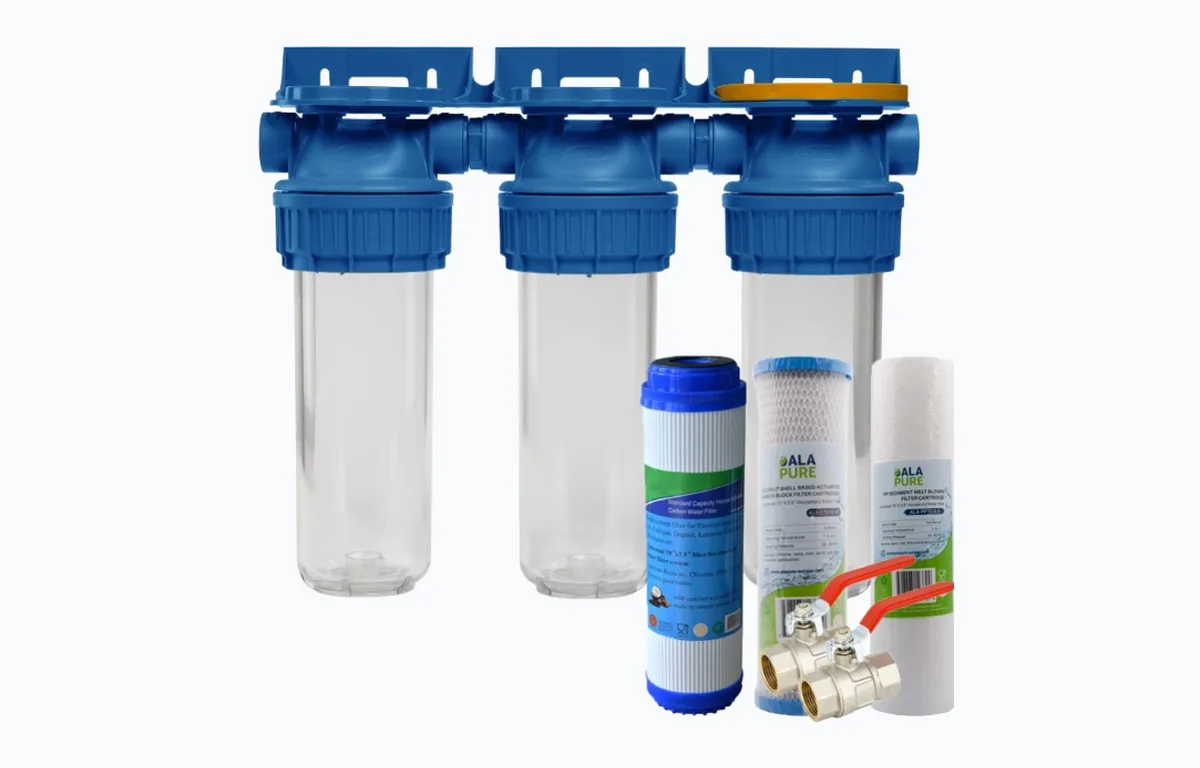
3-stage whole-house filtration system with PFAS carbon filter, from a Dutch supplier.
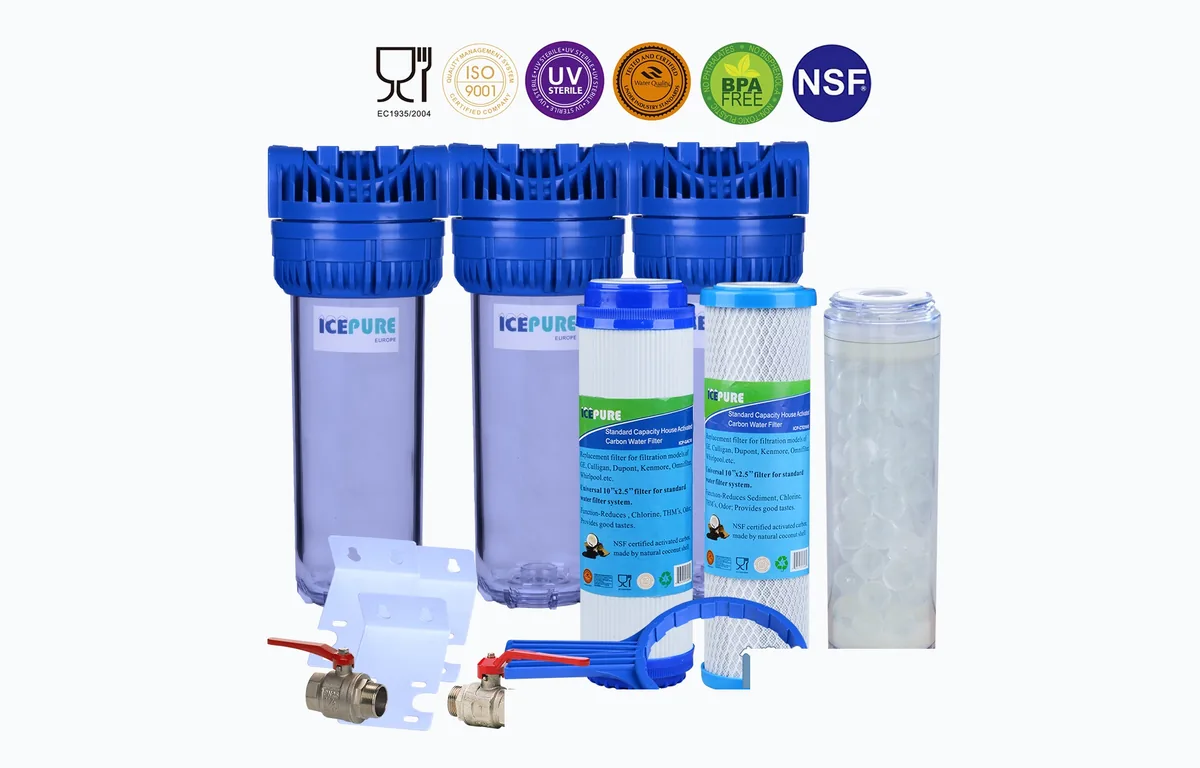
Whole-house system that combines filtration with limescale control, via a Dutch supplier.
Profile D: Specific situation
For less standard situations a few specific recommendations:
- Home from before 1960, possibly lead pipes: an independently certified filter with NSF/ANSI 53 for lead. The AquaTru countertop RO or a British Berkefeld gravity system are the strongest choices here (see the widget below).
- Own well or rainwater: a gravity system with fine ceramic pores against bacteria and parasites. The British Berkefeld is certified for microbiological removal; supplement with UV if the water stands for long periods.
- High personal quality requirements: combine a certified drinking-water system (AquaTru or British Berkefeld) with a whole-house pre-filter for the rest of the home.
Compact 4.5 L variant of the certified British Berkefeld for 1-2 people.
Stainless-steel gravity filter with NSF 401-certified Ultra Sterasyl ceramic element -- the certified Berkey alternative.
Premium integrated kitchen systems
For those getting a new kitchen anyway or considering one, there are integrated systems that combine filtration with other functions (cooling, sparkling water, boiling water). These are a significant investment of €1500 to €5000 or more, but eliminate the need for an extra tap or visible filter installation.
Premium kitchen tap with filtered, chilled and sparkling water; convenience over contaminant filtration.
Premium 5-in-1 tap (boiling, hot, cold, filtered cold, sparkling); convenience, not contaminant filtration.
GROHE Blue Home Mono: kitchen tap with integrated filtration and optional cooling and carbonation. Works on the basis of carbon filtering, not RO. Effective against chlorine and taste, limited against specific contaminants such as PFAS or pharmaceutical residues without an NSF/ANSI 53 claim. Suitable for those who prioritize taste and convenience.
Quooker Flex with COMBI boiler and CUBE reservoir: extension to the well-known Quooker boiling water tap with filtration and sparkling water. Carbon block filtration. Suitable for luxury kitchens with strong design value. Effectiveness claims for specific contaminants vary by model.
Honest expectation management: these systems are premium in terms of convenience, appearance and integration, but rarely offer NSF/ANSI 53 or comparable effectiveness certification for PFAS or pharmaceutical residues. For pure filtration performance per invested euro, an under-sink RO system (€300-600) is substantially stronger than these €2000+ kitchen systems. Those who value convenience and design at least as much as pure filter performance will find a fitting solution here.
What to avoid
Honest about what does not work or is not substantiated.
Magnetic descalers and electromagnetic systems
Claim to “change” limescale through magnetism or electric fields, so that it would deposit less. No independent scientific basis, despite decades of marketing. For those with a limescale problem: invest in a real ion exchanger or silicopolyphosphate system.
Brita Maxtra+ and similar pitcher filters without specific contaminant certification
Good for chlorine removal and taste improvement. Poor for PFAS, pharmaceutical residues, lead. These filters claim nothing specific against these contaminants and performance is limited. If your goal is “better-tasting tap water”, it remains a reasonable option. For those who want to tackle specific contaminants: choose a certified alternative.
“Alkaline water”, “structured water”, “hexagonal water”
Water with pH > 7 (alkaline) is sold with claims about detoxifying the body, better hydration, disease prevention and even cancer prevention. A 2024 systematic review compared alkaline water with regular mineral water and found no measurable differences in gut flora, urine pH, blood parameters or fitness in healthy people.
There is limited evidence for specific groups: athletes appear to get somewhat better rehydration in short interventions, bicarbonate-rich water can help with reflux complaints, and there are some studies in post-menopausal women with osteoporosis suggesting marginal benefits. Body pH is strictly regulated by kidneys and lungs, not by what you drink. Buying a water filter specifically to produce alkaline water is for most users not an evidence-based investment.
UV filters as main filter
Work only against living organisms, not against chemical contaminants. For regular Dutch tap water unnecessary: microbiological purification is already done. Useful only as a supplement for standing water, well water or storage systems, not as a replacement for chemical filtering.
Maintenance is essential
Something many guides forget to mention: a filter is not a buy-and-forget product.
Saturated filters can release substances back through a process called desorption: previously adsorbed molecules detach from the activated carbon and end up flowing along in the filtered water. An expired filter is potentially worse than no filter at all. For bacteria something comparable applies: warm, moist filter materials can become a breeding ground if they remain in use too long.
Replacement schedule per filter type:
| Filter type | Replacement interval |
|---|---|
| Pitcher filter (BWT, Brita, etc.) | 4-8 weeks |
| Under-sink carbon block | 6-12 months |
| RO sediment filter | 6 months |
| RO carbon filter | 6-12 months |
| RO membrane | 2-3 years |
| Ecofiltro filter unit | 2 years |
| Whole-house filters | 6-12 months, pre-filter every 3-6 months |
How do you know replacement is needed? A few indicators:
- Taste change: if filtered water suddenly tastes of chlorine again, the filter is saturated.
- Date tracking: simplest method, note the installation date and set a reminder.
- TDS meter: a digital measurement instrument that measures total dissolved solids in water. Particularly useful with RO systems: an elevated reading on filtered water indicates a failing membrane.
For TDS meters it pays to choose a reliable variant. Quality varies sharply in the market. Cheap meters can deviate 20-30% from the true value, making them practically useless. Choose a meter with:
- Calibration capability (calibration solutions are sold separately)
- NTC temperature compensation (TDS values are temperature-dependent, compensation makes the measurement more reliable)
- Reputable brand such as HM Digital, or a variant supplied by a specialized water filter retailer
Cost over the lifetime
An honest total-cost comparison, not just the purchase price, but the total expenditure over 5 years including replacement filters.
| Type | Purchase | Replacement filters per year | 5 year total |
|---|---|---|---|
| Pitcher filter (BWT/Brita) | €25-50 | €40-80 | €225-450 |
| Tap filter | €30-100 | €40-80 | €230-500 |
| Ecofiltro 5L | €140 | €12 (filter every 2 years) | €200 |
| Doulton gravity-fed | €250-400 | €40-80 | €450-800 |
| Under-sink RO | €200-600 | €60-150 | €500-1350 |
| Alapure ZIP RO | €300-450 | €80-120 | €700-1050 |
| Whole-house filter | €400-1500 | €100-300 | €900-3000 |
| Premium kitchen system (GROHE Blue, Quooker CUBE) | €1500-3500 | €100-200 | €2000-4500 |
The “replacement filters per year” column is the most important cost item after purchase. Filters must be replaced periodically, otherwise they lose their effectiveness or even become a health risk through saturation and bacterial growth. A cheap system with expensive replacement filters can prove more expensive over five years than a more expensive system with better filter economics.
Comparison with bottled water: a family of four drinking 2 liters per person per day spends between €500 and €1000 per year on bottled water. Every filter type pays for itself within a few years, provided it is well maintained.
Conclusion
“The best water filter” does not exist in absolute terms. But for each specific situation a suitable choice does exist.
For the average Dutch household that wants to seriously address both PFAS and pharmaceutical residues: a reverse-osmosis system offers the broadest contaminant removal. The most strongly independently certified options are currently the AquaTru countertop RO and the British Berkefeld gravity systems. An under-sink RO remains a good choice in terms of capacity, but pay attention to certification (see the comparison).
For those who cannot or do not want to install (renters, single people, simplicity-seekers): an Ecofiltro offers surprisingly broad performance without any installation. The independent lab verification makes it a strong evidence-based choice.
For those who just want better-tasting tap water: a simple pitcher filter (BWT, Brita) or carbon system suffices. No reason to buy more expensive than necessary.
For those wanting the premium integrated route: GROHE Blue or Quooker CUBE deliver that, with the honest caveat that filter performance at contaminant level is not their strongest point.
For those wanting to tackle both limescale and chemical contaminants: layered approach with whole-house filter with anti-limescale plus point-of-use RO.
Our certified recommendations
Compare all →
Compact countertop RO in carafe form for 1-2 people, same certification as the Classic.
Countertop reverse-osmosis system requiring no installation, independently certified for 84 contaminants.
Compact 4.5 L variant of the certified British Berkefeld for 1-2 people.
Stainless-steel gravity filter with NSF 401-certified Ultra Sterasyl ceramic element -- the certified Berkey alternative.
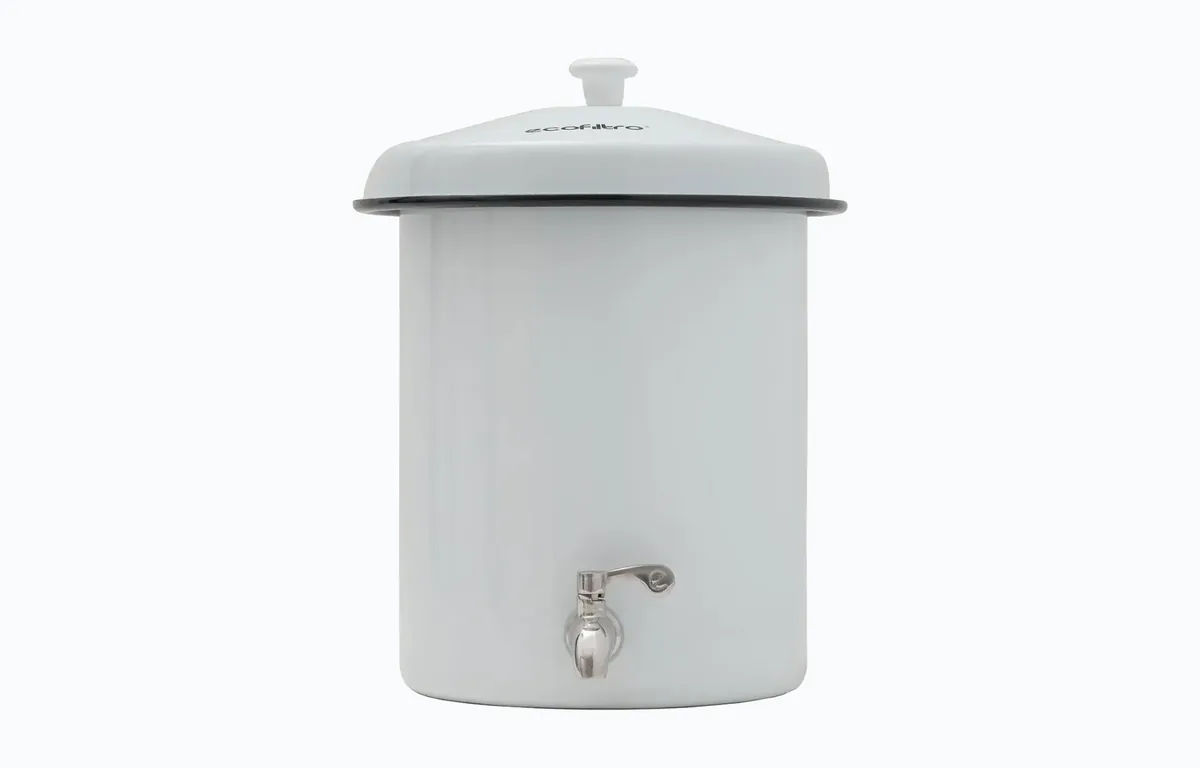
Plastic-free clay gravity filter with colloidal silver and activated carbon, independently lab-tested.
Ceramic under-sink filter with NSF-certified BioTect Ultra element; strong on lead and bacteria.
What applies in all cases: independent certification is more important than expensive marketing. CE marking and Kiwa Water Mark are the European basis. NSF/ANSI 53 for specific contaminant claims, NSF/ANSI 58 for RO performance, DIN and EN standards where applicable: these are the signals to look for. And do not forget: keeping up with maintenance is essential. A well-maintained simple filter works better than a neglected premium system.
Want to read more about what is actually in Dutch tap water and why? Our articles on PFAS in Dutch tap water 2026, pharmaceutical residues in tap water 2026 and microplastics in tap water and bottled water provide the scientific background to the choices in this guide. Want to know where the water comes from and what happens to it? Read about Dutch drinking water treatment and how wastewater is processed.
Affiliate disclosure: as mentioned at the beginning, some links in this article are affiliate links. When you purchase a product via these links, we receive a small commission at no extra cost to you. This does not influence our editorial choices. Read our affiliate disclaimer for more information.
Sources
Dutch authorities and certification
- RIVM (Dutch National Institute for Public Health and the Environment). Materials and chemicals in contact with drinking water.
- Kiwa Netherlands. Drinking Water Directive certification and testing of drinking water products.
- Kiwa Netherlands. Kiwa Watermark certification and testing for chemicals and installations.
- Praktijkcodes Drinkwater (Dutch drinking water practical codes). Certification.
European regulation
- European Union. Directive (EU) 2020/2184 on the quality of water intended for human consumption.
- 4MS Initiative (the Netherlands, Germany, France, United Kingdom, Denmark). Common Approach for materials in contact with drinking water.
Independent certification
- NSF International. NSF/ANSI 42 (taste and odor), NSF/ANSI 53 (specific health contaminants), NSF/ANSI 58 (reverse osmosis), NSF/ANSI 372 (lead-free).
- DIN (Deutsches Institut für Normung): water filter standardization Germany.
- DVGW (Deutsche Vereinigung des Gas- und Wasserfaches): certification Germany.
- WRAS (Water Regulations Advisory Scheme): certification United Kingdom.
Lab studies and scientific literature
- Measurlabs (ISO/IEC 17025 accredited). Ecofiltro filtration effectiveness test results 2024-2025. Independent verification of PFAS, pharmaceutical residue and microplastics removal.
- Sunardi D et al. (2024). Health effects of alkaline, oxygenated, and demineralized water compared to mineral water among healthy population: a systematic review. Reviews on Environmental Health.
- WHO. Pharmaceuticals in drinking-water (2012, reference for pharmaceutical filtering).