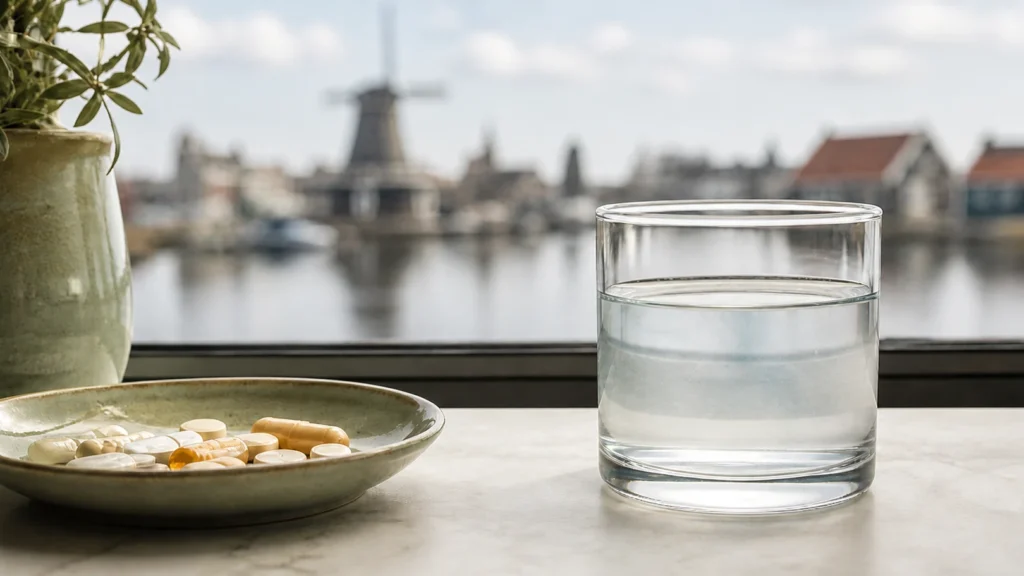
Our society uses ever more medication, and at the individual level that is often a good thing. Painkillers make a workday bearable, antibiotics save lives, antidepressants give people back a functional existence. But every medicine ingested or administered makes a second journey afterwards. Part of it leaves the body via urine and faeces, sometimes via skin creams and gels that wash off, and returns to the environment. It travels through wastewater treatment, into surface water, and eventually sometimes back into the drinking water that comes out of our tap the next day.
Patterns of pharmaceutical pollution are similar across Europe (wherever populations age and consume medication, traces accumulate in surface water), but the specific picture in the Netherlands is shaped by the unusually intense use of river water (Rhine, Meuse) for drinking water production in the western part of the country. This guide explains what is actually in Dutch tap water in 2026 in terms of pharmaceutical residues, how strict and how grounded the current safety assessments are, and what you can realistically do yourself to reduce your exposure.
How pharmaceutical residues end up in your drinking water
The chain from medicine to tap runs through a number of steps that each play their own role, and at multiple points along the way there is room for improvement or conscious choices.
The user as starting point. Practically every ingested medicine is only partially broken down by the body. The remainder leaves the body via urine and faeces in more or less active form. For some substances that share is 5%, for others over 80%. In addition, skin creams, eye drops, hormone patches and infusion fluids play a role. These can enter the sewer system directly via showers and baths, or indirectly through medical waste streams.
The wastewater treatment plant (WWTP) as primary filter. Dutch sewage is treated in roughly 320 facilities spread across the country, managed by the regional water authorities (waterschappen) (read more about how a wastewater treatment plant works). Conventional WWTPs use biological treatment with bacteria, followed by sedimentation and sometimes sand filtration. This works excellently for organic substances and nitrogen, but the fundamental problem is this: WWTPs were never designed to remove pharmaceutical residues. For some medicines they remove 80-90%. For others, such as carbamazepine or X-ray contrast agents, removal is only 0-20%. What remains flows into the surface water. The same gap exists across most European wastewater systems.
Hotspots: hospitals, psychiatric institutions, and pharmaceutical production sites. Not all pharmaceutical waste is evenly distributed. Hospitals are a concentrated source, particularly for X-ray contrast agents (estimated at around 30,000 kilos per year in the Netherlands) and cytostatics (cancer treatment medication). Some Dutch hospitals already apply pre-treatment, for instance through pilot projects with ozone treatment or activated carbon, but this is not a legal requirement and far from common practice across Europe. A patient who has just had a CT scan with contrast fluid contributes for several days afterwards to the pharmaceutical load of the local sewage system. An increasing number of hospitals therefore provide a urine bag to capture the first 24-48 hours of urine separately for incineration rather than discharge. Psychiatric institutions form a similar hotspot for psychotropic drug residues. Pharmaceutical production sites themselves, in the Netherlands as elsewhere in Europe, are a separate category that could be subject to stricter oversight.
From WWTP effluent to surface water. Here a common misconception arises that deserves clarification. Sewage water leaving the treatment facility (effluent) almost invariably ends up in a ditch, canal, or river. But this does not automatically mean it ends up in your drinking water. In the Netherlands, around 66% of drinking water comes from groundwater and 34% from surface water, a higher reliance on groundwater than in countries like Germany (~70%) and lower than in Belgium or France. Groundwater is extracted from depths of tens to hundreds of metres. It takes years to decades for rainwater that infiltrates the upper soil layers to reach those depths. This provides a degree of natural buffering, but also makes the problem persistent. Once contaminated, groundwater stays that way for a long time.
For surface water, the opposite applies. The Meuse, Rhine, and IJsselmeer carry water from large parts of Europe, with all the associated WWTP effluents from millions of people upstream in Germany, France, and Belgium. Drinking water companies that use these sources (especially in western Netherlands and parts of Limburg) must therefore treat more intensively. Yet this still does not mean your glass is a direct dilution of sewage. Between WWTP effluent and drinking water intake there is a complex trajectory of dilution (surface water contains far more water than WWTP effluent), microbial degradation in the river, sedimentation, and then a multi-stage treatment by the drinking water company itself. The net result is that concentrations in drinking water are orders of magnitude lower than in WWTP effluent. But never zero.
Drinking water companies as the final filter. For producing drinking water from surface water, Dutch water companies already apply multiple treatment steps: pre-treatment, slow sand filtration, ozonation, activated carbon filtration, sometimes membrane filtration (see our article on Dutch drinking water treatment for the full overview). For groundwater, this has historically been simpler (aeration and sand filter), but practice is shifting. Due to what RIVM calls the “ageing of the groundwater” (a low-level cocktail of various substances now ubiquitous), more groundwater companies are applying additional treatment. This costs money, and those costs will reach consumers via the water bill. The same trend is visible in groundwater-dependent water utilities across the EU.
What’s actually in there: substances, quantities, scale
RIVM has now detected more than thirty pharmaceutical compounds in Dutch drinking water sources or in treated drinking water itself. The main categories:
- Painkillers and anti-inflammatories: paracetamol, ibuprofen, diclofenac, naproxen
- Antibiotics: sulfamethoxazole, clarithromycin, trimethoprim. Relevant both as residues and because of their contribution to antimicrobial resistance.
- Antidepressants and psychotropic drugs: fluoxetine, oxazepam, and the very poorly biodegradable carbamazepine
- Antihypertensives: metoprolol, atenolol, valsartan
- Hormone preparations: ethinylestradiol from birth control pills, oestrogens from hormone therapy
- X-ray contrast agents: iopamidol, iomeprol, iopromide. Chemically so stable that they barely degrade.
- Anti-epileptics: carbamazepine especially, often in the highest concentrations of all measured substances
- Beta-blockers, statins, antidiabetic medication: in lower concentrations
The total scale is striking, even though individual concentrations are low. According to RIVM calculations, at least 190,000 kilos of pharmaceutical residues end up in Dutch surface water each year, plus another 30,000 kilos of X-ray contrast agents. And these are still conservative estimates, based on prescription medication via public pharmacies. Over-the-counter medicines, hospital medication, and so-called back-formation of breakdown products are not included and could according to RIVM add another 50 to 500 tonnes per year. The Netherlands is not unique in this; comparable per-capita estimates apply to other Western European countries with similar healthcare access.
In drinking water itself, concentrations are much lower than in surface water. For most substances we are talking about nanograms per litre (ng/L), occasionally low micrograms per litre (µg/L) for the most poorly biodegradable substances. RIVM applies a signalling parameter of 1 µg/L for individual substances. Above that concentration, further investigation and possible intervention by the drinking water company follows. In practice, this threshold is rarely exceeded in delivered drinking water.
To put the order of magnitude in concrete terms: at a typical concentration of 20 ng/L paracetamol, drinking two litres of tap water per day for seventy years means a cumulative intake of about half a milligram total via drinking water. That is less than a thousandth of a normal therapeutic dose. This is the factual basis for the reassuring message from government and the sector: no, you do not receive a pharmacologically active dose of medication via your tap.
But this does not end the story.
What science actually knows, and does not know
This is where the tension that defines this dossier lives. The World Health Organization (WHO) published a comprehensive 2012 report concluding that the health risks of pharmaceutical traces in drinking water at current concentrations are “very low”. RIVM confirms this conclusion as recently as 2026: at the levels found in Dutch tap water, no health effects are expected, “even taking mixture toxicity into account”.
At the level of individual pharmacological efficacy, this is correct. For no individual substance is there evidence of direct harm at the concentrations occurring in drinking water.
But there is an uncomfortable residual factor. Researchers like Dr Carsten Prasse (Johns Hopkins University) and Sébastien Sauvé (Université de Montréal) consistently point out that the effect of daily, long-term exposure to a mixture of dozens of biologically active substances simultaneously has not been systematically studied in any single piece of research. Not because research has refuted it, but because it is methodologically extremely difficult and the funding is lacking. The absence of evidence of harm is fundamentally different from evidence of absence of harm.
A few things are already known:
- Endocrine disruption is real in the environment. Ethinylestradiol from birth control pills is biologically active in fish at concentrations of just a few ng/L, with sex changes and reduced reproduction as a consequence. For humans, comparable studies are lacking, but the fact that a substance acts on fish at the ng/L level says something about its potency.
- Antibiotic resistance is no hypothetical risk. Antibiotic residues in surface water demonstrably contribute to the selection of resistant bacteria, and those bacteria can in turn end up in humans. This is a confirmed public health risk, separate from direct exposure to antibiotic molecules.
- Psychotropic drugs affect aquatic organisms directly, even under real WWTP conditions. Not just in the lab. In a Canadian study, goldfish were placed in cages for 21 days directly downstream of a WWTP outlet on Lake Ontario. In their blood plasma, fifteen different pharmaceutical substances were detected, including six antidepressants simultaneously (amitriptyline, citalopram, fluoxetine, sertraline, venlafaxine, and diphenhydramine). Their behaviour changed measurably: less anxiety response, disrupted reproductive behaviour, poorer predator avoidance. Comparable effects have been found with carbamazepine, anti-epileptics and hormone residues. What this means for humans who, throughout their lives, take in such substances at ng/L levels, no one knows.
- Specific vulnerable groups warrant additional caution. Pregnant women and infants have more sensitive systems for hormonally active substances. Older adults already on multiple medications operate within a complex pharmacological interaction profile to which any additional exposure can contribute.
This is not the kind of subject scientists panic over. But it is the kind of subject where the most serious experts publicly say what they suspect: that the current reassuring conclusions will likely be revised over the next twenty years, just as has happened with other environmental contaminants. Waiting for that revision is one option. Or you can choose now to avoid the amounts that can reasonably be avoided.
What lies ahead
This is an aspect missing from most articles on pharmaceutical residues, and it is precisely here that there is much to gain for those who think strategically about their water choices. Three developments together form a growing problem.
Ageing populations and rising medication use. The Dutch population is on average getting older, and older people use considerably more medication. According to RIVM projections, the amount of pharmaceutical residue in surface water could rise by thirty to fifty percent by 2050, despite all efforts to limit prescribing. The same trend applies across most of Europe. At the same time, new medication categories are being used in large volumes. GLP-1 agonists such as Ozempic and Wegovy are increasingly prescribed, not only for diabetes but also for obesity. Their behaviour in wastewater and their ecological effect have barely been studied. The same applies to new biotechnology medicines, cancer immunotherapy, and mRNA-based therapies. What modern pharmacology gains, the environment will eventually invoice on its balance sheet.
Antibiotic resistance as accelerator. Here a frequently heard assumption needs nuancing. For a long time, patients were told by their doctor they “always had to finish” an antibiotic course to prevent resistance. Recent scientific insight shows this advice is no longer well-grounded. Long-term exposure to antibiotics actually selects for resistant bacteria, not shorter courses. WHO has revised its recommendation accordingly: “follow the advice of your prescriber”, which increasingly means a shorter course. The real primary causes of antibiotic resistance lie elsewhere: unnecessary prescribing (for viral infections, for example), self-medication, and large-scale industrial use in livestock farming.
On self-medication, the Netherlands does well internationally. Only about three percent of Dutch adults use antibiotics without prescription, one of the lowest percentages in Europe. By comparison: in Greece this is twenty percent, in Romania sixteen percent, in Latin American countries fourteen to twenty-six percent, and in parts of sub-Saharan Africa up to fifty-five percent. The difference is partly policy: Dutch pharmacies dispense antibiotics in the exact number of pills for a specific course, while in Italy and Lithuania entire packages are issued, with surplus that is later used for self-medication. In countries where antibiotics are sold without prescription, they are also used for viral infections or preventively, with direct consequences for resistance and therefore for the amount of active antibiotic residue in the environment. For travellers to certain countries, “buy three, get one free” deals and antibiotics handed out “just in case” are routine. Antibiotics that enter the world that way contribute disproportionately to a global problem.
EU regulation and the 2045 deadline. The revised European Urban Wastewater Treatment Directive requires all larger wastewater treatment plants in the EU to add a so-called fourth treatment step before 2045, specifically removing pharmaceutical residues and other micropollutants. In practice this means ozone treatment, advanced activated carbon filtration, or nanofiltration. Dutch pilot projects already operate at several locations (including Aarle-Rixtel, Amersfoort, and Horstermeer), with similar pilots running in Germany, Switzerland, and Sweden. Estimated costs run into billions of euros for the country as a whole. That bill will largely reach the water consumer through rising water treatment levies. Estimates suggest an increase of ten to twenty euros per inhabitant per year, rising in later years.
Innovative filtering techniques may bring those costs down in the long term. Dutch companies such as NX Filtration develop hollow fibre membranes that directly remove micropollutants without the chemical steps that ozone treatment requires. This type of innovation enables the transition to cleaner water, but the rollout takes time. Twenty years, to be precise.
Climate change worsens the problem. Drier summers mean lower water levels in rivers and therefore higher concentrations of pharmaceutical residues in surface water used as drinking water source. Dutch drinking water companies had to intervene during the dry periods of 2018 and 2022 by halting intake when concentrations of problem substances temporarily became too high. The same phenomenon has been observed across the Rhine basin and the Po Valley in Italy.
A blind spot slowly coming into view: illegal drugs. So far this article has been about prescription medicines. But research by RIVM and the Trimbos Institute shows that residues of cocaine, MDMA, speed, crystal meth, and designer drugs are also structurally found in Dutch WWTP effluents and surface water. Between November 2023 and November 2024, RIVM conducted a national pilot study at twenty WWTPs spread across the Netherlands, with five measurement moments. The results are public: in larger municipalities significantly more drugs are detected than in smaller ones, even after correcting for population, and use proves to be relatively constant throughout the year. From 2025 onwards the research becomes structural, performed once a year in the same municipalities so that trends can be tracked over time. RIVM publishes the measurement results on a public dashboard, where coronavirus and pharmaceutical residue data are also visible.
This method is becoming increasingly important internationally. The European Union Drugs Agency (EUDA) has for years coordinated a SCORE study, in which 115 cities across 25 European countries were analysed for drug residues in 2025. Amsterdam, Eindhoven, and Utrecht have participated annually since 2011, with KWR as analytical laboratory. The uncomfortable by-product: these substances too, biologically highly active and largely unaffected by conventional WWTPs, contribute to the cocktail of bioactive compounds in the surface water used as drinking water source in western Netherlands. Whether this has a measurable health effect via drinking water has not been investigated. How much of it ultimately reaches your tap after dilution and treatment is an open question that was not even being asked a few years ago.
The European counter-movement: source-based prevention rather than end-of-pipe. In May 2025, PREWAPHARM was launched, an Interreg North-West Europe project with eighteen partners from seven countries, running until the end of 2028. Its approach is fundamentally different from the fourth treatment step: instead of treating pharmaceutical residues after they are already in sewage, the project focuses on prevention at the source. Think greener drug development, better release mechanisms that cause less excretion, education for prescribers, and collection means via pharmacists. Whether this programme delivers tangible results in time remains to be seen, but it is a sign that European policy is finally recognising that treating only addresses the symptom, not the cause.
The three layers — what do the numbers actually mean?
To hold your glass of water against three different yardsticks:
The legal layer: for most pharmaceutical residues, no legal maximum concentration exists in drinking water. The EU Drinking Water Directive covers PFAS, lead, nitrate, and a number of other substances, but pharmaceuticals fall outside its scope with a few exceptions. So there is no standard which tap water “meets” or “fails to meet” for pharmaceutical residues. There is simply no formal standard.
The Dutch signalling layer: RIVM applies a general threshold of 1 µg/L per individual substance as a guideline above which further investigation and possible intervention is required. This value is rarely exceeded in delivered Dutch drinking water. For specific problem substances that have come into focus over recent years (such as lithium), RIVM has carried out additional research and concluded that Dutch concentrations pose no health risk.
The individual optimisation layer: here no formal standard exists because by definition this is not a collective measure. The starting point is simple: your body has no benefit from traces of ibuprofen, oxazepam, or carbamazepine in its daily water balance. For your health, less is always better, however small the absolute amounts. Whether that is significant enough for you to take action is a personal choice that only you can make.
These three layers do not contain tension at the level of “safe or not safe” as with PFAS. But they do at the level of “sufficient for legal compliance” versus “sufficient for your own optimum”. That difference is exactly what this guide is about.
What you can do yourself
With pharmaceutical residues, you have something you don’t have with PFAS: influence on the source, not just on the endpoint. The chain begins with the behaviour of citizens (you and me), and only after that comes treatment and filtering. That gives two points of leverage.
On the source side: responsible medication use
- Always return unused medicines to the pharmacy or municipal chemical waste collection point. Don’t flush them down the toilet or drain, and don’t put them in regular household waste. Pharmacies and municipal collection points use a specialised disposal route via controlled high-temperature incineration (1100°C+ in industrial facilities with flue gas treatment), which fully destroys organic pharmaceutical molecules without releasing them as residue into the environment. This is fundamentally different from regular household waste incineration, where temperatures are lower and substances can still escape via flue gas or ash into air and soil. According to RIVM, only about a fifth of Dutch citizens do this consistently. Small behaviour, large effect at mass scale.
- Ask for a urine bag at a CT scan with contrast fluid. An increasing number of Dutch hospitals provide one as standard. It works simply: you collect the first 24 to 48 hours of urine separately and hand it in for the same controlled incineration. This removes a large part of the contrast agent from the sewage circuit.
- Use antibiotics carefully. Follow your doctor’s prescription. Don’t store leftovers for self-medication later. Avoid “just-in-case” antibiotics, especially when travelling. And realise that the resistance problem is not primarily solved by your finishing the course, but by collectively prescribing less and more accurately.
- Don’t unnecessarily wash off topically applied hormones, gels, and creams immediately after use. The difference often lies in a few hours during which the skin absorbs the substance versus rinsing it off straight away.
These measures cost you nothing. They may not on their own make a world-changing difference, but they are the conscious version of something you do anyway.
On the user side: filtering your drinking water
For those who want to go beyond source action alone, filtering your drinking water is the second step. Not all filter technology is equally effective against pharmaceutical residues:
- Works well: reverse osmosis (RO) removes between 95 and 99% of practically all pharmaceutical residues, including the poorly biodegradable substances such as carbamazepine and X-ray contrast agents. This is the gold standard.
- Works partially: high-quality activated carbon filters with sufficient contact time remove many pharmaceutical residues, but performance varies considerably per substance. Hydrophilic substances pass through more easily than hydrophobic ones. Expect 50 to 90% removal, depending on filter and substance.
- Hardly works: UV filters, sediment filters, and most simple jug filters without specific certification do little against pharmaceutical residues. UV kills microorganisms but leaves molecules untouched. Sediment filters remove suspended particles.
An important caveat. A filter you don’t maintain can become a bigger problem than the problem it’s solving. A saturated activated carbon filter can release previously captured substances back (desorption), and in general, moist filter material is a potential bacterial breeding ground. Filters require active management, not buy-and-forget.
When choosing a filter, it pays to look at independent certifications. NSF/ANSI 53 covers the removal of specific contaminants including some pharmaceuticals, NSF/ANSI 58 is the standard for reverse osmosis systems. A filter without independent certification may work well, but you have no verified basis to assess that.
For a comprehensive comparison of water filters effective against pharmaceutical residues, PFAS, and other micropollutants, see our pillar guide: Best water filter Netherlands 2026 — compared by situation. There we go through the options by household type, water consumption, and budget.
For whom is it worth it? As with other exposures: for anyone who takes their health seriously, this is an optimisation worth considering. Not just for risk groups. A water filter that effectively removes pharmaceutical residues costs a one-off few hundred euros plus annual maintenance. For a family that consumes several litres of drinking water daily, that is an investment that pays back over decades of consciously cleaner water.
What government and sector are doing
At national level, the Chain Approach for Pharmaceutical Residues from Water has been running since 2018. A collaboration between national government, water authorities, drinking water companies, healthcare sector, pharmaceutical industry, and municipalities. The approach has four tracks.
Source approach: prescribing less where this is responsible, education for doctors and patients, alternative treatments where possible, and better registration of what is dispensed where. This is the most fundamental long-term solution but the least quickly visible.
Pharmacy collection points: years of campaigning to move citizens away from flushing unused medicines down toilet or drain. Effective in policy, limited in practice: estimates of the share of medication correctly returned vary from fifteen to thirty percent.
Fourth treatment step at WWTPs: as discussed, EU obligation by 2045, with major investments. Pilot projects are already running, scale-up follows over the coming decades.
Tightening drinking water treatment: drinking water companies processing surface water are investing in advanced oxidation and extensive activated carbon filtration. For groundwater companies, activated carbon filtration is increasingly being built in due to the “ageing” of groundwater with cocktails of various substances.
In February 2026, RIVM published a report identifying five substances putting drinking water quality under pressure. The report describes a mixed group of industrial chemicals and pharmaceutical breakdown products whose measured concentrations are too high for simple treatment. The institute advises the Ministry of Infrastructure and Water Management to carry out additional research for these substances on health risks and treatment requirements.
The overarching reality is that policy is moving in the right direction, but at a pace measured in decades rather than years. Much of what is in your drinking water today landed there through decisions made twenty or thirty years ago. And what will still be in there twenty years from now is determined by decisions made now.
Looking ahead
The coming years bring developments that will change the situation, both for better and for worse.
2027: The Netherlands must comply with the European Water Framework Directive goals. At present no surface water body achieves “good status”, partly because of pharmaceutical residues. Additional measures will be enforced over the coming years. The same enforcement is happening across the EU.
2028-2032: The first large-scale fourth treatment step installations come online. At the same time, the rollout of urine bag systems in hospitals continues to expand.
2030-2045: The EU deadline for mandatory fourth treatment step approaches. Investments rise, water prices rise.
Research: cocktail effect studies at RIVM and through European research programmes will deliver results over the coming years. Biomonitoring of pharmaceutical residues in humans, parallel to what is already happening with PFAS, is on the launch pad.
What will still be in the glass in 2045? The honest assessment: less than now, but not dramatically less. Rising medication use due to ageing populations and new categories of pharmaceuticals will offset some of the gains from better treatment. For those who want to maintain control over their daily exposure, in the long term it remains an actively maintained choice.
Conclusion
Dutch drinking water contains traces of medicines. That is a fact, not shocking and not trivial. It is the unavoidable consequence of a society that collectively uses medication and collectively consumes water, with technology that is not yet quite what it should be.
In the three layers of assessment:
- Legal and signalling: the concentrations found in delivered Dutch drinking water fall well below every applicable threshold value. It is safe in the legal sense of the word.
- Best current scientific insight: the effects of long-term exposure to a mixture of dozens of biologically active substances at ng/L levels have not been studied. Not refuted, not confirmed, not investigated. Reassuring statements are not unfounded, but they are also not based on direct evidence.
- Individual optimisation: less is better. No study has shown that traces of ibuprofen, oxazepam, ethinylestradiol, or cocaine contribute to your health. Cocaine is a notable candidate on this list: it is pharmacologically active at low doses on the sympathetic nervous system (raised heart rate, blood pressure, vasoconstriction) and is structurally found in Dutch WWTP effluents. What can reasonably be avoided is better for your body than what the law allows.
The chain of pharmaceutical residues in water is unique in this dossier because both source and filter lie within your own sphere of influence. The source in the sense that personal medication use and correct return of surplus directly affects the system’s input. The filter in the sense that a well-chosen and well-maintained water filter system stands at the endpoint of the chain.
Waiting for government is a choice, and with pharmaceutical residues that means decades before structural treatment solutions are rolled out. Water prices will rise in the meantime, but the composition of what you consume daily — through your glass, and over time measurably in your own blood — depends on what is in your glass now, not on what will be in there later.
The alternative is active ownership. Conscious prescribing and use, correct return, and for those willing to take the step a filter at the endpoint. Not from fear, but from sober calculation. Drinking the tap water is fine, and in the legal sense it is safe. The question is whether your own optimum equals that.
Want to know which filter type fits your living situation, use, and budget? Our pillar guide Best water filter Netherlands 2026 — compared by situation goes deeper into what works, what doesn’t, and why.
Sources
Dutch authorities and publications
- RIVM. Effects on drinking water and drinking water sources (in Dutch).
- RIVM. Knowledge Network Pharmaceutical Residues (in Dutch).
- RIVM/Deltares. New study confirms: pharmaceutical residues are a risk for surface water quality (in Dutch).
- RIVM. Groundwater (in Dutch).
- Government of the Netherlands. Pharmaceutical residues in water (in Dutch).
- Drinkwaterplatform. Pharmaceutical residues in water (in Dutch).
- Vitens. Pharmaceutical residues in water (in Dutch).
- Compendium for the Living Environment. Drinking water production, 1950-2023 (in Dutch).
- ESB, April 2026. Declining quality of water sources increases drinking water costs (in Dutch).
- Waterforum, February 2026. RIVM: five substances put drinking water quality under pressure (in Dutch).
- Information Point for the Living Environment. Sources for drinking water (in Dutch).
- KWR Water Research Institute, February 2026. Doubling of research projects looking at drug residues in the wastewater system.
- RIVM. Wastewater monitoring dashboard. Publicly accessible overview of measurements.
- RIVM/Trimbos Institute, November 2025. Monitoring drugs in Dutch wastewater — a pilot study (RIVM report 2025-0071) (in Dutch).
- Trimbos Institute. Wastewater research drugs — Dutch and European context (in Dutch).
- Dutch Water Sector / Interreg North-West Europe, February 2026. PREWAPHARM — Preventing Water Pollution by Pharmaceuticals.
International scientific and clinical sources
- WHO (2012). Pharmaceuticals in drinking-water.
- WHO. Antimicrobial resistance: Does stopping a course of antibiotics early lead to antibiotic resistance?
- Llewelyn et al. (2017), BMJ. “The antibiotic course has had its day”.
- Frontiers in Public Health. Determinants of Self-Medication With Antibiotics in European and Anglo-Saxon Countries.
- Springer Nature (2025). The global prevalence of antibiotic self-medication among the adult population.
- PMC. Active pharmaceutical contaminants in drinking water: myth or fact?
- PMC. Reduced anxiety is associated with the accumulation of six serotonin reuptake inhibitors in wastewater treatment effluent exposed goldfish (Lake Ontario, 21-day caging study).
- Tap Score (Johns Hopkins). Pharmaceuticals in Your Drinking Water.
- PMC. Meeting Report: Pharmaceuticals in Water — An Interdisciplinary Approach to a Public Health Challenge.