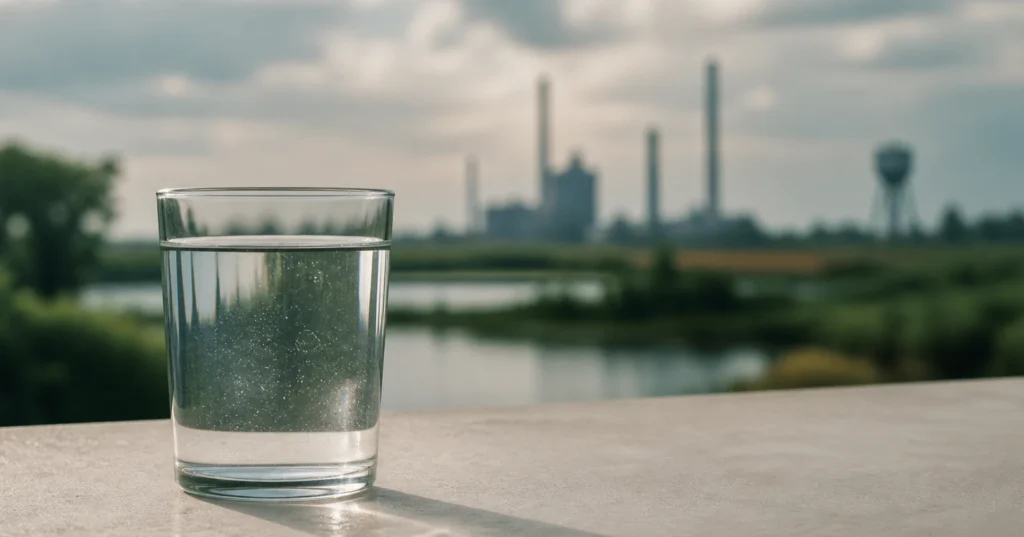
PFAS stands for per- and polyfluoroalkyl substances, a group of more than ten thousand different man-made chemicals. They are water- and grease-repellent, heat-resistant, and chemically extremely stable. These properties make them ideal for non-stick pans, rainwear, firefighting foam, food packaging, and an endless list of other applications. That same stability is precisely the problem. PFAS barely break down in the environment or in the human body. Hence the nickname forever chemicals.
This guide explains what is actually in Dutch tap water in 2026, how strict the current standards are, how they relate to current scientific understanding, and what you can realistically do to reduce your exposure.
What are PFAS, in plain terms
The core of a PFAS molecule is a chain of carbon atoms in which each carbon is surrounded by fluorine atoms. The carbon-fluorine bond is one of the strongest single bonds in organic chemistry. Bacteria don’t digest them, heat doesn’t break them down, and your body eliminates them slowly or not at all. PFAS have half-lives of two to eight years in humans. What you ingest this week is still largely in your system next year.
PFAS enter the environment via three main routes. Industrial production and use: factories that make or process PFAS release them into air, surface water, and soil. Not always legally, not always known to regulators. This is true across the EU, with major Dutch, Belgian, German and Italian sites all contributing to cross-border contamination. Consumer products: non-stick pans, raincoats, ski wax, fast-food packaging, water-repellent sprays. Through use and disposal, the material ends up in wastewater and landfills. Atmospheric deposition: PFAS evaporate or become airborne aerosols and rain down everywhere, including far from the source. Recent measurements show that rainwater worldwide contains ultra-short chain PFAS.
In drinking water, PFAS ultimately arrive via two routes: river water that is treated by drinking water companies (especially in western Netherlands), and groundwater that is slowly contaminated through the soil. Drinking water companies treat what they can, but PFAS removal is technically difficult and expensive. Their treatment installations were not originally designed for it.
The standards: three different limit values, three different worlds
This is where most confusion arises. Different numbers circulate, and they mean different things.
The legal EU standard: 100 nanograms per litre (PFAS-20). Since 12 January 2026, all EU Member States must comply with the new European Drinking Water Directive. It prescribes a maximum of 100 ng/L for the sum of twenty specific PFAS substances. In addition, 500 ng/L applies to “PFAS Total” (a broader group). This is the legal floor. All Dutch drinking water companies meet it. This is what they mean when they say “the tap water is safe”. The same standard now applies across the EU, although individual countries can set stricter national limits.
The guideline value from RIVM (the Dutch National Institute for Public Health and the Environment): 4.4 nanograms per litre. Twenty times stricter. RIVM advised this value in 2022 based on new insights from the European Food Safety Authority (EFSA) in 2020. That newer science had not yet been incorporated into the EU standard. The RIVM guideline value is expressed in PFOA equivalents. Concentrations of individual PFAS are multiplied by a toxicity factor and added together. RIVM proposes this value should eventually become a legal requirement in the Dutch Drinking Water Decree, but that has not happened yet. Germany has adopted a similar approach with its own national guideline values, while Denmark and Sweden have moved in the same direction.
In western Netherlands, where drinking water is largely produced from Rhine and Meuse water, more than half of measurements exceed this RIVM guideline. In groundwater regions, that figure is roughly one in ten. RIVM itself advises lowering these concentrations “where possible”.
The international clinical threshold: 2 nanograms per millilitre in blood serum. This is where it becomes really interesting, and this layer is rarely mentioned in European media. In 2022, the American National Academies of Sciences, Engineering, and Medicine (NASEM) published clinical guidelines for physicians treating patients with PFAS exposure. Their advice, based on human biomonitoring research and EFSA data: at serum concentrations below 2 ng/mL, no adverse effects are expected. Above 2 ng/mL the potential for effects emerges, and above 20 ng/mL NASEM advises physicians to actively help reduce exposure, especially in pregnant patients.
The Institute for Functional Medicine highlights a nested case-control study from the Journal of Hepatology (2022) in which high PFOS concentrations were associated with a 4.5-fold increased risk of non-viral liver cancer.
Recent Dutch biomonitoring research shows that almost all Dutch residents have PFAS serum values above that 2 ng/mL threshold. This pattern is consistent across European biomonitoring studies, with similar elevated levels found in Germany, Belgium, France, and the Nordic countries. Not acutely alarming, but above the level at which health damage may reasonably be expected.
So these are three different worlds. The legal EU standard is a political compromise between industry, the drinking water sector, and environmental interests, based on science that was already outdated when the limit was set. The RIVM guideline is a serious update, but aimed at the average of the population. A societal floor, not an optimum. The NASEM threshold comes closest to what individual health protection would require.
What’s actually in Dutch tap water
At the national level, all Dutch tap water meets the legal EU standard. That is not nothing. The Netherlands historically has one of the most strictly controlled drinking water systems in the world. Drinking water companies take thousands of samples every year, and the Dutch Inspectorate for Human Environment and Transport (ILT) supervises this.
But the national average hides large regional differences. The type of source determines almost entirely how much PFAS ends up in your tap.
Surface water (Rhine and Meuse, mainly western Netherlands). Here, PFAS arrive via the river, with contributions from Germany, Belgium, France, and Dutch industry. This source is the most contaminated. Drinking water companies use powdered carbon, activated carbon, and membrane filtration to lower concentrations, but full removal is not feasible. Comparable challenges apply to drinking water utilities in the German Ruhr region and along the Belgian Schelde, which face similar cross-border pollution.
Groundwater (mainly eastern, northern, and parts of southern Netherlands). Lower concentrations, because the soil acts as a natural filter and PFAS penetrate slowly. Brabant Water reports that its groundwater sources also meet the stricter RIVM guideline.
RIVM states explicitly: drinking water produced from groundwater generally meets the RIVM guideline, drinking water from surface water often does not. That is not a small detail. It is a factual difference in daily exposure between someone in Drenthe (groundwater) and someone in Rotterdam (surface water).
One important nuance about the relative scale of the problem. According to RIVM calculations, people in the Netherlands take in about three times as much PFAS via food as via drinking water. Fish, eggs, fruit, and vegetables all contain traces, especially products from areas near pollution sources. That doesn’t mean drinking water doesn’t matter. It means that a complete approach to exposure reduction tackles multiple routes at once.
Toxicologist Jacob de Boer (VU Amsterdam) phrased it sharply in a March 2026 article from Radar/AVROTROS: “Drinking water is the only knob the government can directly turn right now. Every nanogram you save there immediately reduces the load on the immune system.”
Why this matters: health effects
The health effects of PFAS are no longer hypothetical. Over the past decade, EFSA, NASEM, the American ATSDR and the National Institute of Environmental Health Sciences (NIEHS) have consistently studied PFAS exposure in humans. The effects with the strongest evidence:
- Immune system. Reduced antibody response to vaccinations and infections. According to NASEM, this is the effect with the strongest evidence and occurs at relatively low chronic exposure. Practical consequence: flu, childhood, and COVID vaccines work less well.
- Liver function. Elevated liver enzymes, increased risk of fatty liver disease (MASLD, formerly NAFLD), and in some studies a 4.5-fold increased risk of liver cancer with high PFOS exposure.
- Cholesterol. Higher LDL cholesterol levels in the blood.
- Thyroid. Disrupted thyroid function.
- Fertility and pregnancy. Reduced fertility, lower birth weight, delayed pubertal development. PFAS cross the placenta and are transferred via breast milk.
- Cancer. Increased risk of kidney and testicular cancer with prolonged higher exposure.
One argument deserves emphasis in this guide. Authorities often point to vulnerable groups such as pregnant women, young children, and people with immune disorders, as if PFAS are problematic only for them and not for healthy adults. That is a misleading framing. A substance that weakens the antibody response in a foetus does the same, to a lesser degree, in everyone. A substance that raises cholesterol in a child does the same in a 45-year-old. The evidence is simply easier to demonstrate in sensitive groups because their systems respond at lower thresholds and the effects are more clinically visible. What is safe for a pregnant woman is safer for everyone. What is harmful to an infant is gradually harmful to you.
Where it comes from: sources in the Netherlands
The Netherlands has multiple known industrial PFAS point sources. Three big names, three different stories.
Chemours, Dordrecht. Formerly DuPont, since 1959 a producer of fluoropolymers. Long history of direct discharges into the Beneden-Merwede river and indirect discharges via the sewer system. Since 2012, Chemours has used GenX technology as a replacement for the banned PFOA. GenX (HFPO-DA) itself turns out to be a PFAS with comparable problems. In 2025, DCMR (the regional environmental agency) forced Chemours to drastically reduce a new substance, TFA (trifluoroacetic acid). From a requested 1,500 kilos per year in 2025 to a maximum of 67 kilos from 2026 onwards. The Public Prosecution Service is conducting a criminal investigation against DuPont and Chemours for possibly unlawful emissions.
SABIC, Bergen op Zoom. Plastics manufacturer. Discharged PFBS (perfluorobutane sulfonic acid) into the Westerschelde estuary for 25 years, since the 1990s, without a permit and without informing the province. The province of North Brabant only discovered this in 2022, after 51 kilos per year of unreported discharges. The province imposed a limit of 2.75 kilos per year for 2025-2026. SABIC appealed but lost. The Westerschelde flows between the Netherlands and Belgium, making this a cross-border environmental issue.
Custom Powders, Helmond. A British company that processed Teflon powder for DuPont/Chemours until its bankruptcy in 2024. Discharged large quantities of PFOA and related PFAS into the Helmond sewer system for at least fifteen years. According to investigative programme Zembla, DuPont knew about the discharges. As recently as 2021, concentrations of 6:2 FTS up to 49,000 ng/L were measured in wastewater — three hundred times higher than the legal drinking water limit for PFAS. The municipality of Helmond estimates remediation costs at at least ten million euros.
In addition, there are foreign point sources whose discharges reach Dutch drinking water via rivers. Notably 3M in Antwerp and Indaver (waste processing) in Antwerp discharge large quantities of PFAS via the Schelde. German industry contributes via the Rhine. Diffuse sources such as PFAS-containing firefighting foam (at airports, fire stations, and military sites) have contaminated local groundwater for decades. PFAS-containing firefighting foam is now being phased out across the EU, with an end date of 23 October 2030 for most applications.
Scientific attention is shifting toward ultra-short chain PFAS such as TFA. These shorter molecules were barely studied until recently because older measuring equipment did not detect them. TFA is increasingly found in rainwater, groundwater, and even grain products. A warning that the known landscape of PFAS contamination is probably only the tip of the iceberg.
Jurjen Jongepier (Vewin, the Dutch Association of Drinking Water Companies) summarised the structural limitation concisely in March 2026: “Water boards stand at the end of the chain: we treat the wastewater that comes in via the sewer. But we don’t determine which substances companies produce or use. As long as substances like PFAS are produced, we’ll keep mopping with the tap running.”
What is the government doing?
There are moving parts at various levels, with mixed effectiveness.
At EU level, the Netherlands, Germany, Denmark, Sweden, and Norway have been working since January 2023 on a joint PFAS restriction proposal at the European Chemicals Agency (ECHA). The proposal runs to more than three thousand pages and was updated in August 2025 based on six thousand stakeholder responses. Important steps were taken in March 2026: ECHA’s Risk Assessment Committee (RAC) adopted its final opinion on 3 March 2026, and the Socio-Economic Analysis Committee (SEAC) finalised its draft opinion on 11 March 2026. Both committees support an EU-wide restriction, with specific derogations. After final opinions are adopted, any restriction can be set by the European Commission, with transition periods for industry.
At national level, the RIVM PFAS research programme runs from 2023 to the end of 2026, commissioned by three ministries. The Dutch government has a national PFAS action programme with budget. The ILT controls drinking water companies and enforces against industrial discharges.
At provincial and municipal level, provinces issue permits for industrial discharges, municipalities for some local aspects. Rijkswaterstaat (the Dutch executive agency for public works and water management) issues permits for direct discharges into national waters. DCMR Environmental Service Rijnmond supervises Chemours on behalf of Zuid-Holland. The province of North Brabant does the same for SABIC.
One administrative fact deserves mention. In February 2026, the District Court in The Hague ruled that the State is “doing enough” against PFAS contamination. Four regional environmental organisations and the Foundation Healthy Water had demanded a ban on PFAS discharges and a faster approach. The court rejected this: the government may largely decide for itself how it tackles the issue. For those who hoped the legal route might bring quick relief, this was a serious setback.
The uncomfortable conclusion: improvements are happening, but at a pace measured in years and decades, not months. Meanwhile, PFAS-containing products and industrial processes continue. The reality is that government wheels grind on, and your exposure today is largely unaffected by tomorrow’s decisions.
What you can do yourself
Here we come to the part where you have real influence. The starting point: actively reducing PFAS exposure is neither a panic reaction nor an exaggeration. It is a form of lifestyle optimisation suited to anyone who takes their health seriously. The RIVM guideline value is useful as a societal improvement, but it is not an optimum for your body. For individual health, a simple principle applies: less PFAS is better, regardless of whether you live in western or eastern Netherlands, regardless of your age or risk profile.
A number of concrete measures that make the difference.
Eat consciously. The largest exposure route is food, three times the size of water. RIVM advises against regularly eating self-caught freshwater fish from Dutch waters. In areas around Chemours, SABIC, or former military sites with firefighting foam, caution with vegetables from your own garden is wise. Variation in food sources reduces the risk of cumulative exposure from a single contaminated source. Preference for products from outside known contamination zones, and for organic products where possible.
Avoid direct consumer sources. Non-stick pans with worn coating (the PFAS comes loose), water-repellent sprays for clothing and shoes, fast-food packaging with grease-resistant coatings, and microwave popcorn bags are all direct contact sources. Glass, stainless steel, and cast-iron cookware are PFAS-free. Home-cooked meals instead of fast food. Untreated leather or untreated fabric instead of impregnation sprays.
Filter your drinking water — selectively and thoughtfully. Not all water filters remove PFAS. Some do almost nothing against them.
- Works well: reverse osmosis (RO) removes 95-99% of most PFAS, including the difficult short-chain variants.
- Works partially: high-quality activated carbon filters, especially properly engineered “block carbon” systems. Some types remove long-chain PFAS well but short-chain poorly.
- Doesn’t work: UV filters, sediment filters, most simple jug filters without specific PFAS certification.
An important caveat rarely mentioned elsewhere: a filter you don’t maintain can become a greater risk than the problem you’re trying to solve. Toxicologist Jacob de Boer warns: “If you don’t replace a filter strictly on time, it can become a breeding ground for bacteria. In the short term, that poses a greater health risk than the PFAS.” So a filter is not a buy-and-forget purchase, but a household component requiring active management.
When choosing a filter, it is worth looking at independent certifications. NSF/ANSI 53 is the relevant standard for PFAS removal (specifically PFOA and PFOS), NSF/ANSI 58 for reverse osmosis. A filter without that certification is a gamble.
Currently live is a comprehensive, evidence-based comparison of water filters effective against PFAS, by situation. See our pillar guide: Best water filter Netherlands 2026 — compared by situation .
Boiling doesn’t help. A common misconception. Boiling your water is supposed to remove PFAS. The opposite is true. PFAS easily survive high temperatures, and because some of the water evaporates, the concentration in the remaining water can even slightly increase.
Looking ahead
What’s expected to happen in the next few years?
In 2026, ECHA finalises the scientific evaluation of the EU PFAS restriction proposal. SEAC is working toward a final opinion, after which the dossier goes to the European Commission for decision-making. The RIVM research programme ends in late 2026, with findings to be published. Any EU ban could come into force from 2027, with transition periods for industry running until the end of the decade. For firefighting foam, concrete end dates already apply. PFOA-containing foam has been banned since December 2025, portable extinguishers will follow by 2027 at the latest, most other applications by 2030.
In 2027, RIVM will publish results from health studies in the regions around Chemours and the Westerschelde. These regional studies could substantially change understanding of local health effects.
For drinking water treatment, the trend is clear. Drinking water companies will invest in more advanced treatment technology. That has an unpleasant flip side: it is expensive, and those costs will end up on consumers’ water bills. The water price could rise significantly in the coming years.
Scientific attention is shifting further toward ultra-short chain PFAS, biomonitoring (blood testing of residents near point sources), and alternative treatment technologies. Internationally, growing research is examining blood plasma donation and menstruation as routes to reduce PFAS levels in the body — a notable consideration for those who measure high personal serum values.
Conclusion
Dutch tap water meets the law. That is a fact, and it would be wrong to dismiss it. The Dutch drinking water system is one of the most strictly controlled in the world, and PFAS concentrations are not exceptionally high by international standards.
But this guide is not about what the law requires. It is about what optimising your health requires, and there a fundamental gap exists.
Three layers of standards, three different worlds:
- The legal EU standard (100 ng/L) is a political compromise. Outdated at the time of adoption. It guarantees that the tap water is not acutely sickening, no more than that.
- The RIVM guideline (4.4 ng/L) is a serious scientific update for the societal average. Twenty times sharper, intended as a target for the drinking water sector in time. But it remains a collective objective, not individual optimisation.
- International clinical thresholds (NASEM 2 ng/mL serum) come closest to what individual protection would require. And almost all Dutch residents exceed them.
That last layer is where the difference between “it’s allowed” and “it’s good for you” lives. Between the world of permits and the world of common sense. A substance that weakens the antibody response in a pregnant foetus does so, to a lesser degree, in everyone. A substance that accumulates in body tissue with half-lives of years, accumulates in everyone. The vulnerable groups that authorities point to are not exceptions. They are the first signals of a wider reality.
So there is no reason to look at the legal standard for lifestyle decisions. Legal standards are a floor, not a guide for how to manage your health optimally. Waiting for the government to fix it is a choice — a choice in which you accept that your serum levels will keep rising for now, that remediation takes years, and that the supply of new PFAS via consumer products simply continues.
The alternative is active ownership. Conscious eating. Smart filtering. Avoiding unnecessary consumer sources. Not a panic reaction, but a sober optimisation under your own control. For most people that costs at most some extra attention and a one-off investment in good materials. The benefits are permanent.
Drinking the tap water is fine. The question is whether you want to. Not from fear, but from the awareness that any amount you can reasonably avoid is better than the amount the law allows.
Sources
Dutch authorities and publications
- RIVM. PFAS in Drinking Water.
- RIVM. PFAS in Dutch drinking water compared with the new European Drinking Water Directive and relation to the EFSA health-based guidance value.
- RIVM. Questions and answers about excessive PFAS exposure.
- RIVM. Current PFAS news and research.
- Drinkwaterplatform. 7 questions about PFAS in drinking water (in Dutch).
- Brabant Water. PFAS and drinking water (in Dutch).
- DCMR. Chemours, Delrin (DuPont) and Dow file (in Dutch).
- Province of Zuid-Holland. Chemours dossier (in Dutch).
- ILT/Utrecht University. PFAS sources in the Netherlands — Source investigation based on monitoring data (in Dutch).
Dutch media and judicial rulings
- Radar (AVROTROS), March 2026. PFAS in Dutch drinking water: a balance between law and health (in Dutch).
- NOS, October 2025. Manufacturer Sabic must reduce PFAS discharge in Westerschelde (in Dutch).
- NOS, April 2025. Factory in Helmond discharged PFAS into sewer for years (Custom Powders, in Dutch).
- Change Inc, February 2026. State doing enough against PFAS spread (in Dutch).
European regulation and authorities
- European Union. Directive (EU) 2020/2184 on the quality of water intended for human consumption.
- ECHA. Per- and polyfluoroalkyl substances (PFAS) — hot topics.
- ECHA, August 2025. ECHA publishes updated PFAS restriction proposal.
- ECHA, March 2026. ECHA supports PFAS restriction with targeted derogations.
International scientific and clinical sources
- National Academies of Sciences, Engineering, and Medicine (NASEM, 2022). Guidance on PFAS Exposure, Testing, and Clinical Follow-Up.
- Institute for Functional Medicine. PFAS, the Forever Chemicals: Human Health Impact & Interventions.
- ATSDR (CDC). Health Effects: PFAS Information for Clinicians.
- NIEHS. Perfluoroalkyl and Polyfluoroalkyl Substances (PFAS).
- Health Impacts of Per- and Polyfluoroalkyl Substances (PFASs): A Comprehensive Review, 2024. Available via PMC.