Water boards treat, municipalities collect
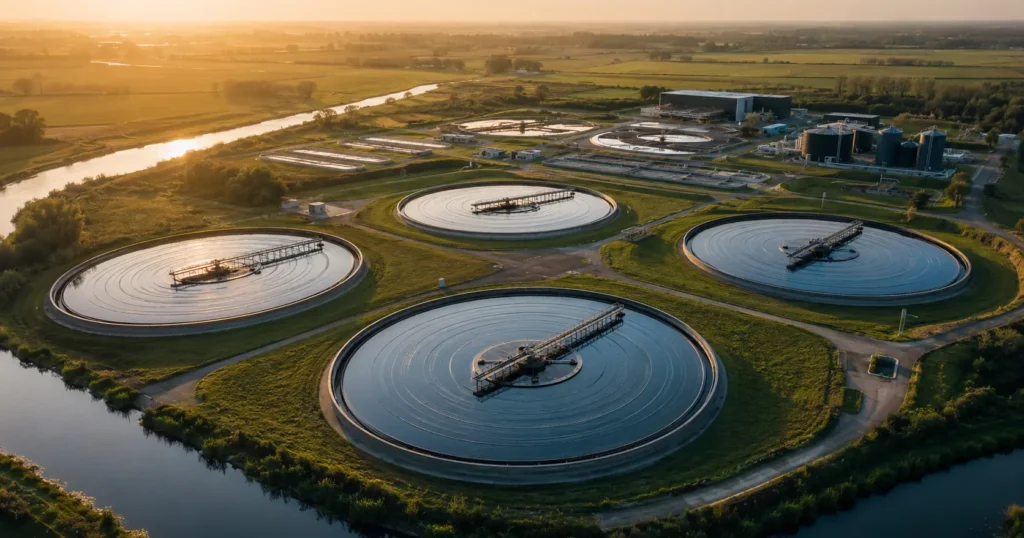
The Dutch water chain is split between municipalities and water boards, and there is logic behind it. Municipalities manage the sewer system within their borders: the pipes under the streets, the manholes, the pumping stations that move wastewater away. Water boards (the oldest democratic governance layer in the Netherlands, dating back to the medieval period) treat the wastewater and are allowed to discharge it cleanly back into surface water. At the handover points, responsibility shifts from municipality to water board. This division dates from a time when cities built their own sewers while water boards had managed the wider water system for centuries.
According to Statistics Netherlands, the 21 Dutch water boards together operate 313 wastewater treatment plants (figures from October 2023, the most recent official count). In addition there are two privately operated plants, and part of the municipality of Baarle-Nassau is treated by Belgian facilities, a historical curiosity that reflects the famously tangled border between the Netherlands and Belgium in that area.
A WWTP (in Dutch: RWZI, rioolwaterzuiveringsinstallatie) is identical to an AWZI (afvalwaterzuiveringsinstallatie); both terms are used by water boards. The newer label “resource factory” or “energy factory” describes the same kind of facility but emphasises that a modern WWTP doesn’t just treat water but also generates biogas and recovers phosphate.
What most people don’t realise is that the current Dutch infrastructure was largely built between 1970 and 1995. Before that period most urban wastewater in the Netherlands was discharged untreated into rivers, canals and lakes. The Rhine in the 1970s was so polluted it had a global reputation as Europe’s open sewer. The first EU Urban Waste Water Treatment Directive of 1991 codified what was already underway in the Netherlands and forced laggard countries to catch up. Thirty-five years later, Europe stands on the threshold of a second great construction wave. More on that later.
There is one more complication that makes the story more interesting: not everything entering a WWTP is domestic wastewater. It can also be rainwater carried in via combined sewer systems, plus groundwater seeping in through cracks. In 2024, 49% of the hardened urban surface in the Netherlands was still connected to combined sewers. That has consequences which come back later in this article.
The four standard treatment steps
What happens to wastewater at a WWTP differs by installation, but the basic process is the same everywhere. Four main steps, taking 12 to 24 hours in total. To give you a sense of scale: the Den Bosch WWTP operated by water board Aa en Maas processes 45 million litres of wastewater per day, enough to fill eighteen Olympic swimming pools.
Step 1, pre-treatment (15 to 30 minutes). Raw sewage first flows through a screen with openings of a few centimetres. What comes out is not a pretty sight: plastic, wet wipes, sanitary products, sticks and everything else people put down toilets that shouldn’t be there. Next comes a grit chamber where heavy material settles to the bottom, and a fat separator where oil and grease rise to the surface and are skimmed off. What remains is turbid water that looks unappealing but has already lost its coarsest contents.
Step 2, primary clarification (1 to 3 hours). Water flows slowly through large settling tanks. Fine suspended particles sink to the bottom as primary sludge. The clearer water that flows over the top moves on to biological treatment.
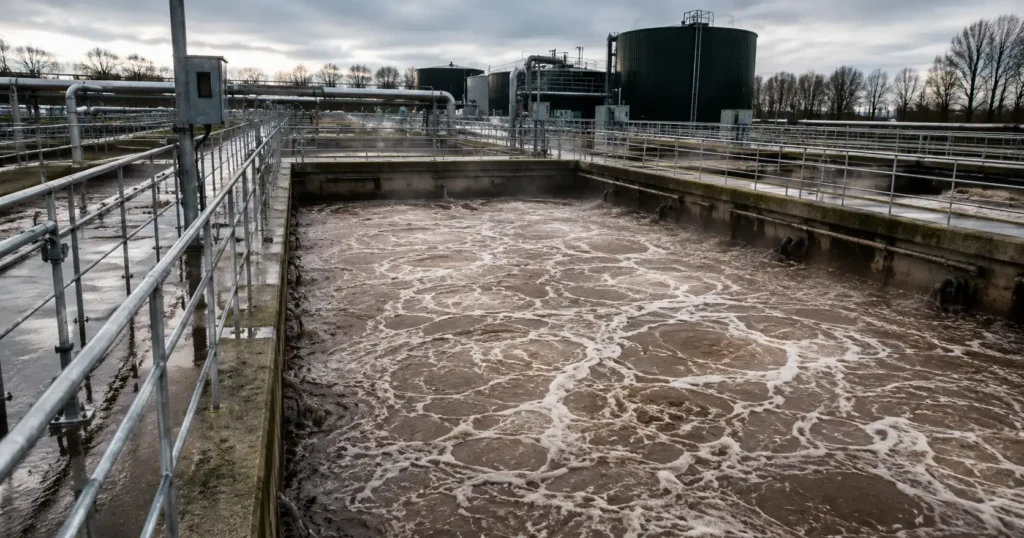
Step 3, biological treatment (6 to 12 hours). This is the core of the process, and also the most fascinating part. In large aeration tanks billions of bacteria break down organic matter, the same biological decomposition that happens in nature, but accelerated and concentrated. Nitrogen is removed via a two-step process that mimics the physics of wet soils: nitrifying bacteria convert ammonium to nitrate, then denitrifying bacteria convert that nitrate to nitrogen gas, which escapes to the atmosphere. Phosphorus is chemically bound to iron or aluminium salts and precipitates as sludge. According to Statistics Netherlands, Dutch WWTPs remove on average 84% of all nitrogen and 86% of all phosphorus from incoming wastewater, impressive results for a biological process at this scale.
Step 4, secondary clarification (2 to 4 hours). The water carrying the bacterial mass flows into clarification tanks where the active sludge settles. Part of it is pumped back to the aeration tanks to maintain the bacterial population; the rest goes to sludge processing. The clear water flowing over the top is the effluent: treated wastewater that returns to surface water via ditches, streams or canals.
The effluent must meet the discharge standards of the EU Water Framework Directive. These standards set limits for oxygen-demanding substances, nitrogen, phosphorus and suspended solids. For pharmaceutical residues, PFAS and microplastics there are still no binding discharge standards, a point that comes back later in this article in detail.
Want to know which WWTP processes your wastewater and how that facility works? Many water boards publish tours and explanations of their plants on their own websites, often with videos and infographics. Search for the name of your water board followed by “RWZI” or “rondleiding” (tour). To find out which water board your address falls under, waterschappen.nl offers a postcode lookup.
Sludge is no longer waste, but a resource
Treating wastewater for a city of 100,000 people produces tens of tonnes of sludge every day. That sludge used to be a waste problem; modern WWTPs increasingly treat it as a resource.
In a sludge digester, organic matter in the sludge is broken down by anaerobic bacteria (bacteria that work without oxygen) into biogas. That biogas consists of 60 to 70% methane and is burned on site in a combined heat and power unit (CHP) to generate electricity and heat. More than 70 Dutch WWTPs generate electricity from their own sludge in this way; nine plants operate as “energy factories” with the ambition of being energy-neutral. According to the Dutch Water Authorities Association, water boards produced a total of 134 million cubic metres of biogas in 2024, a third of which was upgraded to 22 million cubic metres of green gas.
A Dutch technical innovation that draws international attention in this field is Nereda technology. Developed in the Netherlands in collaboration with Royal HaskoningDHV and TU Delft, it was first applied at full scale in 2005 at the WWTP in Epe, the world’s first installation at that scale. Nereda works with aerobic granular sludge: bacteria grow together in compact, stable granules instead of as loose flocs in suspension. The advantages are that Nereda needs less space, consumes less energy and simultaneously removes nitrogen and phosphorus better. The technology has since been applied in dozens of countries.
Alongside energy, phosphate is also recovered. At several WWTPs struvite is produced: a mineral of magnesium, ammonium and phosphate that can be used directly as a slow-release fertiliser. Production is modest, a few thousand tonnes per year, but its importance is growing now that phosphate reserves are finite globally and Morocco, which holds more than 70% of global reserves, occupies a strategic position that leaves Europe vulnerable.
The Achilles heel: pharmaceutical residues and micropollutants
The four standard treatment steps are designed to remove organic matter and nutrients. They are good at that. But for the growing group of micropollutants (pharmaceutical residues, endocrine disruptors, pesticides, industrial chemicals and designer drugs) they fall short. Standard biological treatment removes on average 30 to 40% of pharmaceutical residues. The rest leaves the WWTP via the effluent and enters surface water, where it affects water quality and can return to humans and animals via drinking water intake or direct exposure.
This is not a Dutch problem. It is a European problem. And the solution being developed everywhere is the same: add an advanced extra treatment step that specifically captures these substances. Switzerland led the way. On 1 January 2016 a revised Water Protection Ordinance came into force in that country, requiring approximately 100 of Switzerland’s 700 WWTPs (those serving important surface waters) to install an extra treatment step that removes at least 80% of twelve indicator substances. Deadline: 2035. Estimated cost: 1.2 billion Swiss francs. Financing flows through a striking instrument: every Swiss resident pays an annual contribution of 9 francs until 2034 into a federal fund that subsidises WWTPs for up to 75% of investment costs. A resident of a connected WWTP is exempt from the levy as soon as the plant’s extra step is operational.
The Netherlands followed later and on a smaller scale with the IenW Acceleration Programme for Pharmaceutical Residue Removal: a subsidy scheme of 60 million euros for 2021 through 2027. By the end of 2023, four Dutch installations were operational at full scale. Two work with PACAS (powdered activated carbon in activated sludge), in which finely ground activated carbon is dosed into the aeration tank: WWTP Leiden-Noord (Hoogheemraadschap van Rijnland) and WWTP Oijen (Aa en Maas). The other two work with ozonation, where ozone chemically breaks down pharmaceutical molecules: WWTP Wervershoof (Hollands Noorderkwartier) and WWTP Houten (De Stichtse Rijnlanden). By the end of 2023, seven of the 21 water boards had such a step in use or under construction.
In Germany something similar is happening at a larger scale and with much more money. At the Schönerlinde WWTP north of Berlin, which processes the wastewater of 850,000 people, Berliner Wasserbetriebe is currently building an ozonation facility. The entire upgrade of all six Berlin WWTPs is estimated at 584 million dollars. Estimates for equipping all 600 large German WWTPs with advanced treatment range from 10.6 to 47 billion dollars, and the German pharmaceutical industry actively disputes those estimates: a report by Pharma Deutschland concluded in August 2025 that the actual costs will be almost three times higher than the German municipal umbrella organisation VKU predicts.
NX Filtration: nanofiltration from the east of the Netherlands
Alongside PACAS and ozone, a third approach is being actively studied in the Netherlands: direct nanofiltration with hollow-fibre membranes. The Enschede-based company NX Filtration has developed membranes that capture pharmaceutical residues, nanoplastics, dyes and other micropollutants in a single step, without chemicals.
Since May 2022, a pilot has been running at WWTP Enschede of water board Vechtstromen, as part of the UPPWATER programme, a national research programme on the removal of pharmaceutical residues from wastewater. The location is not a coincidence: Enschede scores high in STOWA hotspot analyses for pharmaceutical residues due to the heavy urban load and the presence of large healthcare institutions including the top clinical hospital MST. At WWTP Asten of water board Aa en Maas, nanofiltration is being combined with UV light and hydrogen peroxide. STOWA research at that facility showed that one of the tested membranes, even without follow-up oxidation, already achieves the required 70% removal rate; with oxidation the theoretical rate rises to 88% for most guide substances.
The technology is promising but not yet ready for standard rollout at large WWTPs. Pilot installations operate at a flow rate of one hundred to one thousand litres per hour, while a mid-size WWTP processes millions of litres per day. NX Filtration now has installations running internationally too, in Helsingborg (Sweden) and Nice (France), and opened a new production facility in Hengelo in 2024. The expectation is that the technology will play a role in the rollout that the new European directive requires from 2033 onwards, especially at locations where the effluent has a high-value destination such as reuse for industrial processes or greenhouse horticulture.
What the effluent itself doesn’t capture
A WWTP that meets all discharge standards still sends substances into surface water that don’t belong there. That isn’t a flaw of the installation but a consequence of the fact that standards are set for what we knew and could measure when they were drafted.
PFAS is a category of thousands of chemicals that are barely degradable due to their strong carbon-fluorine bond. Traditional treatment captures some PFAS compounds partially through adsorption to sludge, but short-chain PFAS and trifluoroacetic acid (TFA, a PFAS breakdown product) largely pass through the treatment process. The Dutch Water Authorities Association explicitly emphasises that WWTPs were never designed to remove PFAS, and advocates source-based control rather than end-of-pipe measures. What PFAS in Dutch tap water means for your health is covered in our article on PFAS in tap water.
Nanoplastics and microplastics enter the sewer through synthetic clothing fibres, packaging material and tyre wear. Larger microplastics are mostly captured in the sludge, but particles smaller than 10 micrometres largely leave the WWTP via the effluent. What that means for your drinking water is in our article on microplastics in tap water and bottled water.
Antibiotic-resistant bacteria and resistance genes are strongly reduced by biological treatment but not entirely eliminated. What leaves with the effluent can contribute to the spread of resistance in surface water. This is one of the reasons RIVM monitors wastewater for antimicrobial resistance.
Micropollutants in the broadest sense: not just pharmaceuticals, but also cosmetic ingredients like triclosan, endocrine disruptors from sunscreen and plastic, designer drugs and industrial chemicals that have never been on any standards list. The Dutch Water Authorities Association estimates that if all known micropollutants are considered together, a traditional WWTP removes on average less than half. For what ends up in your drinking water, our article on pharmaceutical residues in drinking water is good follow-up reading.
Unknown polluters: the Custom Powders problem
What the Custom Powders case made painfully clear in 2025 is that the treatment system depends on what comes in. And that there are companies that stay out of sight. The Helmond company Custom Powders, which dried Teflon powder on behalf of Chemours, dumped wastewater containing extremely high concentrations of PFAS straight into the Helmond sewer system for fifteen years. Investigative TV programme Zembla broke the story in April 2025. Residents had, unknowingly, PFOA levels in their blood that measurements showed were up to 1,000 times higher than the current RIVM standard. The clean-up costs 10 million euros, paid largely by taxpayers. The company itself has gone bankrupt. The water board had already measured elevated GenX concentrations at the Aarle-Rixtel WWTP in 2018 and identified the source, but at the time that did not lead to adequate enforcement.
How is that possible? In principle, only companies with a permit may discharge into the Dutch sewer system, and the permit specifies which substances are allowed in what concentrations. But oversight is fragmented: municipalities handle the connection permit, environmental services handle the environmental permit, and water boards measure only what enters their WWTPs, identifying deviations only after the fact and without immediate source identification. The Acceleration Programme Urban Water 2025-2030 and the implementation of the new Environment Act should improve this, but enforcement capacity and monitoring technology remain bottlenecks. For substances not screened in standard WWTP measurements (such as new or little-known micropollutants) illegal discharges remain practically invisible until someone specifically goes looking.
The Custom Powders case is not isolated within Europe. Comparable scandals have surfaced around 3M in Belgium (Zwijndrecht), Solvay in Italy and AGC in Germany. The vulnerability of the sewer system as an industrial dumping channel is a European-wide problem; the Netherlands is responding by tightening permits and increasing inspection capacity, but the underlying gap between what’s measured at the plant and what’s actually discharged is structural.
For anyone wanting to report a suspected discharge: every water board has a water quality reporting point, and for suspicion of serious environmental crime the Inspectorate for the Environment and Transport (ILT) can be notified.
The other problem: combined sewer overflows
So far this story has been about what happens once wastewater reaches the WWTP. But that’s not always the case. During heavy rainfall a mechanism activates that many residents don’t know about: the combined sewer overflow.
In the Netherlands, 49% of the hardened urban surface is connected to a combined sewer system: one pipe for both domestic wastewater and stormwater. Under normal rainfall this is fine, but during a heavy downpour the inflow to the WWTP can become so large that the system can’t handle it. To prevent sewage from spilling onto streets, the sewer relieves itself via overflows: a mixture of sewage and stormwater is discharged directly to surface water, untreated.
The good news: overflows operate less than 1% of the time annually; net, about 0.3% of wastewater is discharged via overflow. The bad news: precisely in those brief moments, the discharges are concentrated enough to seriously degrade local water quality. Combined sewer overflows are the reason water boards issue swimming bans for open water during and after heavy rain, from Amsterdam (Amstel, Gooi en Vecht) down to Limburg (Waterschap Limburg) and everywhere in between. Climate change is making the problem worse: annual overflow volume has increased by an average of 1.2% per year since the 1950s, meaning that overflow volume calculated with rainfall data from 2015 to 2024 is about 70% higher than calculations based on rainfall from the 1950s.
This is a problem shared across Europe. Brussels, Paris and London all struggle with combined sewer overflows, and during the 2024 Paris Olympics the question of whether the Seine would be clean enough for open-water swimming events made international headlines precisely because of this issue. Solutions are not at the WWTP but further upstream: disconnecting rainwater from the combined sewer so that clean stormwater can infiltrate the soil locally or be discharged to surface water, and redesigning cities as so-called “sponge cities” with permeable pavement, green roofs and bioswales. STOWA and the Dutch Water Authorities Association are working on guidelines to help municipalities make that transition.
Anyone wanting to know where overflows are located in their own municipality will not find that information in one central place. The PDOK Urban Water (Sewerage) dataset from Stichting RIONED contains geographic data on sewers, to which many municipalities have linked their overflow points. Many municipalities and water boards also publish their own maps; search for “riooloverstorten” plus the name of your municipality or water board. Under the Dutch Open Government Act they are required to provide this information on request.
Where to look up water quality yourself
A logical follow-up question to an article like this is: how is the water in my area doing? In the Netherlands that is remarkably well documented, but the information is spread across different portals. And the picture is rosier than reality.
Start with the big picture. According to the Statistics Netherlands SDG 6 monitor for 2024, 0.0% of the protected surface water area meets the chemical quality standard of the EU Water Framework Directive. That doesn’t mean all water is toxic; it means that everywhere at least one substance exceeds the standard. Only 5.1% of the area has good biological quality. At the same time, in that same year 71.3% of natural swimming water received the qualification “excellent”. That contrast isn’t a measurement error. It’s a consequence of what is measured: swimming water testing is a bacteriological test (E. coli, intestinal enterococci, sometimes blue-green algae) and says nothing about chemical contamination like PFAS, pharmaceutical residues or pesticides. Good swimming water therefore doesn’t mean clean water.
Why doesn’t the EU Bathing Water Directive (2006/7/EC) test for chemicals? Three reasons. Acute health risks from one swim come almost exclusively from bacteria and viruses (gastrointestinal infections); chemicals only cause problems with long-term exposure via drinking water or food. Bacteriological measurements are fast, cheap and reproducible; chemical screening for hundreds of substances is not. And the European legislator placed chemical water quality monitoring under the Water Framework Directive, which evaluates the entire water system instead of just swimming locations. The system is therefore not broken, but “excellent swimming water” signs say something about one type of risk, not about what chemicals are still flowing past.
For swimming water: zwemwater.nl and waterkaart.net show maps of all 889 official swimming locations in the Netherlands, with current water quality ratings and swimming advisories. Provinces test weekly for bacteria and algae during the swimming season.
For chemical and ecological quality of rivers, lakes and canals: waterkwaliteitsportaal.nl, managed by the Information House Water. Here you’ll find detailed measurement data, evaluations and fact sheets per water body (the WFD units of the Water Framework Directive). Also available: the Atlas of Our Environment, which visualises the “toxic pressure” from harmful substances.
For those who want to see the current state of the rivers where drinking water is taken: Rijkswaterstaat publishes measurements for the Rhine, Meuse, IJsselmeer and other national waters.
RIVM wastewater monitoring: thirty years of quiet surveillance
While WWTPs treat wastewater, researchers at RIVM (the Dutch National Institute for Public Health and the Environment) have for three decades been doing something different with that same water: measuring what’s in it, to track the health of the population.
It started in 1992 with polio surveillance. The polio virus spreads through the faeces of infected people and survives in wastewater. By taking weekly samples at WWTPs, RIVM could detect early whether the virus was circulating in a region, even in people without symptoms. From August 2020 the research was scaled up to a national surveillance network for SARS-CoV-2. RIVM currently receives weekly samples from more than 300 WWTPs, monitoring the wastewater of over 17 million people. Because infected people shed the virus via faeces before they show symptoms, an increase in wastewater is visible on average 4 to 7 days earlier than in hospital admissions.
In 2022 RIVM demonstrated that mpox virus DNA is detectable in wastewater, a method now also being investigated for measles, which has been circulating again since 2025. From November 2023 to November 2024, RIVM and the Trimbos Institute conducted a drug pilot on behalf of the ministries of Health and Justice. Five times during the year, samples were taken at twenty WWTPs across the country and analysed for cocaine, crystal meth, amphetamines, MDMA and the designer drugs 3-CMC and 4-CMC. The conclusion: wastewater monitoring provides a representative picture of drug consumption patterns, confirming what surveys already suggested: per capita usage in large municipalities is structurally higher than in small ones.
The potential reaches further. RIVM professor Ana Maria de Roda Husman noted in an RIVM interview that stress, lifestyle, alcohol and nicotine use, and even non-communicable diseases like diabetes and certain types of cancer can also be detected in wastewater. The method has four properties that traditional surveillance lacks. It is anonymous: measurements cannot be traced to individuals. It is fast: excretion via faeces is measurable within 24 to 48 hours after exposure. It is complete: everyone connected to the sewer contributes, not just those who report to a doctor. And it is cost-effective: one sample at a WWTP yields information about tens of thousands of people at once. The main limitation is that wastewater monitoring cannot always distinguish between direct discharge of a substance and excretion by people who have ingested it.
The Dutch approach has become an international reference. The European Centre for Disease Prevention and Control (ECDC) maintains a sewage surveillance network with similar methodology in EU member states, and the WHO has explicitly cited the Dutch model in its global wastewater surveillance guidance.
The RIVM dashboard: what’s in it for you
Most RIVM data from wastewater appears in scientific publications. One dataset is public and available in real time: the SARS-CoV-2 measurements via coronadashboard.rijksoverheid.nl/landelijk/rioolwater. On that page you can see, per WWTP, how many virus particles per 100,000 inhabitants are being measured, how that compares to the national trend, and how recent weeks compare to earlier waves.
That’s useful information. An increase in wastewater measurements signals a new wave on average 4 to 7 days earlier than an increase in hospital admissions. For people in vulnerable situations, the graph offers a more accurate picture of the actual circulation level than the number of officially reported cases, which depends heavily on who gets tested. Look up your WWTP by your municipality’s name: medium-size cities have their own facility, smaller municipalities fall under a regional WWTP. Statistics Netherlands data links every address in the Netherlands to a specific WWTP.
From 7 July 2025 the measurement frequency has been reduced to one measurement per week for approximately 40% of installations. Historical data going back to 2020 remains available via RIVM’s open data portal. For anyone wondering what’s known about pharmaceutical use, drug use and infectious diseases in their own area: the RIVM publication pages on the drug pilot and the coronavirus overview offer the most detailed context.
The 2024 EU directive: a sweeping overhaul
In January 2025 the new EU Urban Waste Water Treatment Directive (UWWTD) entered into force. The directive replaces the 1991 version and introduces, for the first time, an EU-wide legal obligation for an advanced micropollutant removal step at large installations. Four elements matter for what this means in practice.
An ambitious timeline. WWTPs above 150,000 population equivalents (PE) are first in line. A PE represents the pollution load of one person per day; a 150,000 PE facility therefore processes the wastewater of a city of comparable size. Of those large installations, 20% must have an advanced step operational by 2033, 60% by 2039 and 100% by 2045. The directive applies to all 27 EU member states and brings together what was previously a patchwork of national rules: Switzerland (not an EU member) had been ahead since 2016, while Germany, the Netherlands and France had voluntary or regional programmes, and most southern and eastern European countries had no programme at all.
The price tag is enormous at the national level. The European Commission estimated in December 2025 that annual costs for the whole of Europe at full rollout will be 1.48 to 1.8 billion euros per year. That sounds substantial but is misleadingly low compared to the one-off investments required: Germany alone faces 10.6 to 47 billion dollars in one-off construction costs for its 600 large WWTPs, and Switzerland has reserved 1.2 billion francs for 100 installations. The 1.48 to 1.8 billion euros is the European annualised cost after rollout; over a twenty-year rollout, it amounts to 30 to 36 billion euros in investments plus operating costs.
A contested financing model. The EU chose Extended Producer Responsibility (EPR): pharmaceutical companies and cosmetics manufacturers must pay at least 80% of the costs of the advanced treatment step, based on the polluter pays principle. The EU substantiated this with data showing that these two sectors are responsible for 92% of micropollutants in urban wastewater. The pharmaceutical industry filed lawsuits at the European Court of Justice, arguing that the cost estimates were unsound, that the designation of two sectors was arbitrary and that other polluters (chemical industry, agriculture, unknown dischargers like Custom Powders) were left out. In February 2026 the Court rejected those cases. The criticism about the regulation’s blind spots therefore remains.
Comparison with Switzerland. Switzerland chose in 2014 a fundamentally different financing model: a flat levy of 9 francs per Swiss resident per year, paid by everyone. That is defensible in principle (everyone pollutes a little, everyone pays a little) and politically easier, because no single sector is targeted, so no single sector will sue. The EU chose the opposite: the polluter pays, with sharply defined categories. Whether that choice is legally durable became clear in February 2026; whether it is politically durable in the long term, especially in countries where the pharmaceutical lobby is strong, is much less certain.
What this means for your water board levy. The remaining 20% of costs, plus all costs for unknown polluters, end up with water boards and therefore with citizens via the water board levy. In 2025 Dutch water boards budgeted 2.0 billion euros for treatment and pollution levies, almost 7% more than in 2024. That amount will continue to rise over the coming decades as investments in advanced treatment steps and energy neutrality are made.
How the Netherlands compares to its neighbours
The Netherlands is doing well by European standards, but is not exceptional. Switzerland is the clear leader: a targeted obligation for 100 WWTPs, a working financing model since 2016, and operational data from nearly a decade of practical experience that has shown that operating costs have fallen by 20 to 30% at optimised plants thanks to learning effects.
Germany is bigger and more complex. Berlin is investing heavily in the Schönerlinde WWTP (850,000 PE), which will receive not only a new ozonation facility but also three wind turbines and an experimental hydrogen-methane system intended to make the plant energy positive. AFRY is planning comparable upgrades in Berlin Schönerlinde, Herford and Münster. At the same time, fierce political debates are underway over who will pay the bill.
The Netherlands sits somewhere in the middle. We have innovative technology (Nereda, NX Filtration), a working subsidy scheme that has already activated seven water boards, and a wastewater dashboard that was internationally cited as an example during the COVID-19 pandemic. But the Netherlands also has a problem that others know less about: a densely populated delta where all rivers flow to the sea and where the effluent from one WWTP is often quickly the intake for the next drinking water company. What dilutes in a Swiss lake or a German river is, in the Netherlands, back in someone else’s glass after just a few dozen kilometres.
There is also a useful European comparison to consider: Mediterranean countries like Spain, Italy and Portugal have moved much faster towards effluent reuse for agriculture and groundwater recharge, driven by water scarcity. In Almería (Spain) and the Algarve (Portugal), more than half of treated effluent now goes directly to greenhouse horticulture or aquifer recharge instead of into the sea. The Netherlands, with its abundance of fresh water, has barely felt this pressure, but climate change and increasing summer drought are starting to put effluent reuse on the agenda here too.
The effluent of a Dutch WWTP flows via ditches, streams and canals to the Meuse, the Rhine and the IJsselmeer. Those same rivers are, in the west of the Netherlands, intake sources for drinking water companies like Dunea, Evides and PWN, which then apply their own complete treatment chain. How that drinking water treatment process works, how it handles the micropollutants that WWTPs don’t remove, and what may still be in your glass despite all those steps, is in our article on drinking water treatment in the Netherlands. For anyone wanting to take one more step at home after that, our comparison of the best water filters for the Netherlands gives an honest overview of what works and for whom.
What you can do yourself
Not everything starts at the WWTP. A significant share of what enters the facility arrived there because of choices people make at home. Not everything can be solved by individual behaviour, but enough to make it worthwhile.
Don’t flush medication, don’t pour it down the sink. Pharmaceutical residues are the biggest challenge for WWTPs and the next link in the chain: drinking water treatment. Leftover medication belongs at the pharmacy, where it is processed via specialised disposal. Incorrect disposal not only causes environmental damage, but also raises the water board levy for everyone.
Bring fats, oils and dairy residues to a collection point. Frying oil, cooking oil and dairy residues disrupt the biological process and clog pipes and pumps. Bring them to a municipal collection point or to the dedicated frying-oil collection bin (not the regular waste container).
Wet wipes and sanitary products in the residual waste bin. These products don’t dissolve in water and end up as plastic fibres and microplastics in the environment. The Dutch Water Authorities Association is even lobbying at EU level for a ban on plastics in wet wipes. That shows how unsustainable the problem has become. See also our article on microplastics in tap water for the broader context.
Limit products with microplastics and hard-to-degrade substances. Synthetic clothing sheds microscopic fibres with every wash. A washing machine microfibre filter captures some of these. Antibacterial soaps and cleaning products with triclosan, antibiotic residues or certain preservatives largely pass through WWTPs unimpeded. As an alternative: choose products without the labels “antibacterial” or “antibiotic” unless medically necessary.
No paint, chemicals or pharmaceuticals down the toilet. Two-component paint, turpentine, coolant, expired medication: they belong at a chemical waste depot. For those without a car, a municipal collection point can often arrange pickup by appointment.
Investigate water quality in your region. Almost all water boards publish effluent quality reports on their websites. For central information see the water quality portal, the Atlas of Our Environment and for swimming water zwemwater.nl. For current COVID-19 circulation in your wastewater: coronadashboard.rijksoverheid.nl/landelijk/rioolwater.
Avoid swimming in urban water during or after heavy rain. This is possibly the most concrete thing you can do for your own health. Combined sewer overflows arise especially during sudden heavy rain and summer thunderstorms. Urban water boards like Amstel, Gooi en Vecht actively issue negative swimming advisories after such events. Follow them.
Report suspected illegal discharges. Every water board has a water quality reporting point, often via their own website or a shared number for environmental complaints. For serious environmental crime (for example systematic illegal discharges by a company) the Inspectorate for the Environment and Transport (ILT) is the authority. The Custom Powders case shows that alertness from outsiders can make a difference.
Sources
Water boards and policy
- Dutch Water Authorities Association, wastewater treatment plants
- Waterschappen.nl, RWZI explanation
- Statistics Netherlands, residents per WWTP, 1-1-2024
- Statistics Netherlands, water board levies 2025
- Statistics Netherlands, SDG 6 Clean Water and Sanitation (Monitor of Well-being 2025)
Look up water quality yourself
- Water Quality Portal, WFD map viewer
- Atlas of Our Environment, surface water quality
- Zwemwater.nl and Waterkaart, all swimming spots
- Rijkswaterstaat, water quality national waters
- EU Bathing Water Directive 2006/7/EC
- PDOK, Urban Water (Sewerage) dataset
Advanced treatment and innovation
- STOWA, nanofiltration and UV/peroxide pilot, WWTP Asten (2023)
- University of Twente, membrane pilot WWTP Enschede (2022)
- H2O Waternetwerk, WWTP Enschede UPPWATER programme (2025)
Illegal discharges (Custom Powders)
- Omroep Brabant, 15 years of illegal PFAS discharge (2025)
- Dutch government, answers to parliamentary questions Custom Powders (June 2025)
RIVM wastewater monitoring
- RIVM, wastewater monitoring overview
- RIVM, wastewater monitoring coronavirus
- RIVM, wastewater monitoring drugs (November 2025)
- RIVM Magazine, wastewater as a health indicator (2021)
- Coronadashboard Rijksoverheid
European context and regulation
- EU Directive 2024/3019, urban wastewater
- Joint Research Centre, updated quaternary treatment cost estimate (2025)
- Yale E360, EU plan to slash micropollutants (2025)
- Water Europe, CJEU confirms EPR (February 2026)
- AFRY, Switzerland pioneering micropollutants removal
- Smart Water Magazine, cost of new directive (December 2025)
Climate, combined sewer overflows and stormwater