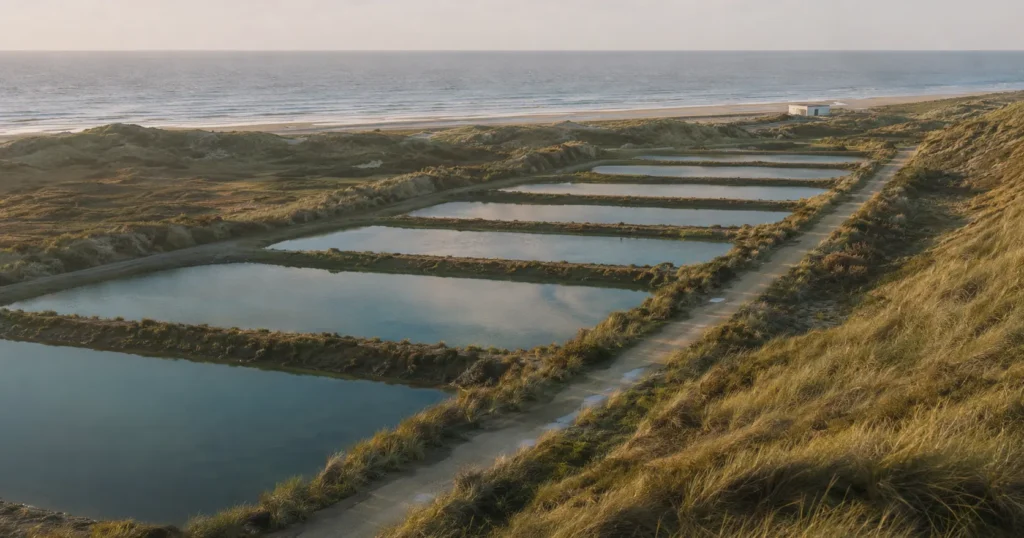
The three types of drinking water sources in the Netherlands
According to the Drinkwaterplatform, the Netherlands has ten drinking water companies that together supply approximately 1.2 billion cubic metres of drinking water annually to 17 million people. These companies work with three types of sources.
Groundwater accounts for roughly 55% of Dutch drinking water. It is rainwater that seeped into the soil decades to millennia ago and accumulated at 20 to 300 metres depth. During that slow journey, the soil filters the water naturally. Vitens, the largest drinking water utility, exclusively uses groundwater and has 110 extraction sites spread across the provinces of Friesland, Overijssel, Flevoland, Gelderland and Utrecht. Brabant Water extracts water from up to 300 metres depth in the Brabant subsoil.
Surface water provides about 40% of Dutch drinking water and comes from rivers and lakes. Dunea extracts from the Afgedamde Maas (a branch of the Meuse), with the Lek as backup. Waternet draws two-thirds of its water from the Lekkanaal near Nieuwegein, supplemented from the Bethunepolder. PWN uses the IJsselmeer as its main source, taken in at Andijk. Evides works with Meuse water and the Haringvliet. Surface water is vulnerable to contamination from agriculture, industry and households upstream.
Dune water is a hybrid form and unique to the Netherlands. Pre-treated river water is infiltrated into the dunes between Katwijk and Monster or in the Amsterdam Water Supply Dunes, where it descends through the soil for 60 to 90 days before being pumped up. The freshwater reservoir beneath the dunes acts both as storage and as a natural filter. Dunea, Waternet and PWN all use this method.
Which company supplies your water is determined by your postcode. You can look this up via the website of Vewin, the trade association of the Dutch drinking water companies. The difference in source has direct consequences for what ends up in your glass, even though everything meets the same legal standards.
How groundwater treatment works
Groundwater has the advantage that nature has done most of the work already. Because rainwater seeps through sand, clay and gravel layers for centuries to millennia, bacteria, viruses and most organic contaminants are almost completely captured. What remains is water that naturally contains more minerals, is often iron- and manganese-rich and has low oxygen levels.
Treatment at a groundwater utility therefore involves a limited number of steps. First, the pumped water is aerated, adding oxygen and releasing carbon dioxide and methane. Next, it flows through rapid sand filters that catch the oxidised iron and manganese compounds formed by aeration. Sometimes a second filtration or activated carbon stage follows. Finally, the water is pressurised and sent into the distribution network.
Vitens describes on its own production page that this basic process is applied at most of its production locations, sometimes supplemented with softening steps to reduce limescale build-up at consumers’ taps. For most contaminants, the process is effective because the soil itself has already done the heavy lifting.
However, there are two growing challenges for groundwater utilities. The first is nitrate and pesticide leaching from agricultural areas, which is approaching legal limits at some extraction sites. The second is that some highly mobile substances such as trifluoroacetic acid (TFA, a PFAS breakdown product) do enter groundwater because they are small and water-soluble enough to descend along with it. Research by the Dutch National Institute for Public Health and the Environment (RIVM) led to an indicative drinking water guideline of 2.2 micrograms per litre for TFA. In Flanders, values up to 12 micrograms per litre were recently measured in drinking water reservoirs, well above this guideline, prompting political pressure for a ban on PFAS-containing pesticides. Comparable specific measurements in the Netherlands are scarcer, but Vitens and other groundwater utilities are actively monitoring TFA because the substance also enters Dutch groundwater via leaching from crop protection products.
How surface water treatment works
For surface water utilities, the story is fundamentally different. Raw water from a river or lake contains suspended particles, organic compounds, bacteria, viruses, micropollutants from industrial discharges, and human and animal waste. Multiple treatment steps are needed before this is drinkable.
The chain begins with pre-treatment near the intake point. Dunea pumps Meuse water from Brakel to the pumping station at Bergambacht, where it passes through 24 dual-layer rapid filters. PWN pre-treats IJsselmeer water at Andijk using a combination of coagulation (where iron or aluminium salts are added to make small particles clump together), sedimentation and filtration. The pre-treated stream is then clear but still contains many dissolved substances.
The next step varies per company. Some send the water directly to dune infiltration (see next section), others first apply advanced oxidation or dose with ozone. At Dunea, part of the Bergambacht effluent has received extra treatment since 2018 in the GOBAM system, a combination of ozone, hydrogen peroxide and low-pressure UV light. This process breaks down organic micropollutants before the water enters the dunes.
After soil passage or advanced oxidation, final treatment follows. Here, ozone, granular activated carbon (GAC) and sand filtration are deployed to remove the last traces of organic compounds, odour and taste. The process often ends with UV disinfection or a low chlorine dose as a safety barrier for the distribution network. Chlorine is rarely used in the Netherlands to kill bacteria, unlike in many other countries, because the combination of treatment and closed pipe network makes it unnecessary.
The full chain takes days to months for surface water, depending on whether soil passage or dune infiltration is included. For groundwater, it is typically just a few hours.
Dune infiltration: a Dutch invention
In 1940, the Leidsche Duinwatermaatschappij became the first in the Netherlands to artificially infiltrate surface water into the dunes. Since 1954, this technique has been applied on a large scale by PWN in the North Holland dunes, by Waternet in the Amsterdam Water Supply Dunes and since 1955 by Dunea in the dunes between Katwijk and Monster. According to Dunea itself, this process, using the dunes as a filter, is unique in the world.
How does it work exactly? Pre-treated river water is pumped via large pipelines to dune infiltration areas and introduced into the soil through open ponds or deep infiltration. The water then descends through 20 to 30 metres of sand layers, where three processes happen simultaneously. First, the soil acts as a mechanical filter that catches fine particles. Second, bacteria in the sand layers break down organic compounds, often including pharmaceutical residues and other micropollutants. Third, some substances are adsorbed onto organic material or minerals in the soil.
After an average of 60 to 90 days, the water seeps up at the other side of the infiltration area. It is then microbiologically safe, clear and largely free of the problematic contaminants originally present in the river water. KWR Water Research Institute has documented in multiple studies how effective soil passage is. In recent research, 31 out of 48 examined organic micropollutants were removed by more than 80% by the combination of advanced oxidation and dune infiltration.
Dune infiltration has a second function beyond water treatment: nature management. Dunea manages 2,420 hectares of dune area between Monster and Katwijk, where rare bird and butterfly species live partly thanks to the water management driven by the infiltration. The Solleveld, Meijendel and Berkheide dune areas together attract about one million visitors per year. The Amsterdam Water Supply Dunes are similarly combined production and nature areas, freely accessible to walkers. According to Dunea, this is an example of “multifunctional land use” that hardly exists anywhere else in Europe.
What happens to all that saturated sand?
A fair question is what happens to soil layers that absorb contaminants year in, year out. Drinking water companies actively maintain their infiltration areas, particularly the top layer of the infiltration ponds where a so-called sludge layer or “Schmutzdecke” forms. This layer of organic material, fine particles and biofilm is both a problem and part of the solution: it provides extra treatment through bacterial breakdown, but when it becomes too thick it impedes water flow. According to KWR research, this sludge layer is mechanically scraped off periodically, typically once every one to a few years depending on the system, after which the sludge is removed and the pond is clean again.
The deeper sand layers beneath the ponds function as a much larger and slower-regenerating filter. Bacterial breakdown, adsorption to iron and aluminium oxides in the soil, and chemical binding ensure that many organic contaminants are actually broken down rather than just retained. For non-degradable substances (such as some PFAS) there is slow accumulation in the soil. This is one reason Dunea has been using the GOBAM system since 2018: advanced oxidation before infiltration reduces the load on the soil itself.
There are also strict rules about what can happen above ground in and around infiltration areas. They are usually Natura 2000 nature reserves where agriculture, industry and construction are excluded. Dutch drinking water companies together manage approximately 23,000 hectares of nature area in the Netherlands, specifically to protect their sources.
However, the technique is under pressure. The freshwater supply beneath the dunes was already becoming too small in the 1950s due to population growth, and had to be supplemented with river water. Today, surface water sources are under pressure from PFAS contamination, pharmaceutical residues and salinisation. Dunea announced in September 2025 plans to develop a new intake point and pre-treatment along the Vliet in Leidschendam-Voorburg, to produce an additional 10 billion litres of drinking water annually from 2030 on top of the current 85 to 90 billion litres from the dunes.
Advanced techniques: ozone, activated carbon and UV
For substances that are caught neither in natural soil passage nor in standard sand filtration, drinking water companies are increasingly deploying advanced techniques.
Ozone treatment is one of the oldest advanced steps. Ozone (O3) is a strongly oxidising gas that breaks down organic molecules by chemically modifying them. It works effectively against many pharmaceutical residues, flavouring substances and dyes. A drawback is that in water with natural bromide, carcinogenic bromate can form as a by-product. Drinking water companies therefore continuously monitor bromate concentration and adjust the ozone dose.
Granular activated carbon (GAC) works on a different principle. Activated carbon has an enormous internal surface area of 500 to 1,500 square metres per gram, comparable to several football fields in a handful. Contaminants stick to this surface via adsorption. GAC is effective against chlorine, taste and odour substances, many pesticides and a portion of PFAS. Short-chain PFAS such as TFA, however, are less well captured, and the filter eventually becomes saturated and must be regenerated or replaced.
Advanced Oxidation Processes (AOP) combine two or more oxidants to create hydroxyl radicals, which break down almost any organic compound. Dunea developed the GOBAM process (Bergambacht Advanced Oxidation), a combination of ozone, hydrogen peroxide and low-pressure UV. PWN has used the LowLox system at Andijk since 2014, a UV-H2O2 technique. These processes are energy-intensive but remove broad-spectrum micropollutants that other steps let pass.
UV disinfection is deployed at the end of the chain to neutralise any bacteria and viruses without adding chemicals. With sufficient radiation dose, pathogens are inactivated within seconds. UV does not change dissolved substances, however, so this step serves purely for microbiological safety.
Nanofiltration and reverse osmosis are membrane techniques that push water under pressure through very fine membranes. Nanofiltration retains larger molecules (around 1 nanometre pore size), reverse osmosis nearly everything except water molecules (0.0001 micrometres). Both techniques are mostly applied at industrial scale or in emergencies, not standard in Dutch drinking water production because they are expensive and waste water. The Dutch company NX Filtration develops nanofiltration membranes that remove microplastics, nanoplastics, PFAS, pharmaceutical residues and pesticides in a single step, and demonstrated the technique at the Twentekanaal.
What is removed and what is not
Here it is important to be honest. Dutch drinking water treatment is excellent for the vast majority of known contaminants, but no process catches everything. Research by the dune and surface water utilities Dunea, PWN, Waternet and Evides has examined more than 100 organic micropollutants over 20 years. The general conclusion: the treatment processes form a robust but not total barrier.
What is almost always removed:
- Bacteria and viruses: standard treatment plus UV or soil passage removes these completely. The Netherlands has almost no tap water-related infectious diseases as a result.
- Suspended particles and turbidity: rapid filters and sand filtration handle this completely.
- Taste and odour substances: activated carbon makes water odourless and taste-neutral.
- Chlorine and chloramines: not relevant in the Netherlands because we do not structurally dose these, but GAC would catch them.
What is partially removed:
- Pharmaceutical residues: approximately 60 to 80% via standard treatment plus activated carbon. Advanced oxidation can bring this to 90 to 99%. Read more in our article on pharmaceutical residues in Dutch drinking water.
- Long-chain PFAS: substances such as PFOS and PFOA are removed for 70 to 95% by GAC. Short-chain and ultra-short-chain PFAS (TFA, GenX) largely remain in the water. The full story is in PFAS in Dutch tap water 2026.
- Microplastics larger than 50 µm: drinking water treatment catches these largely. Nanoplastics (smaller than 1 µm) are harder to detect and to remove. See microplastics in tap water and bottled water.
- Pesticides: activated carbon works well for most, but a few highly mobile molecules pass through.
What is not or hardly removed:
- Limescale (calcium and magnesium): standard treatment does not remove this. Some companies (Vitens, Waternet) soften partially, others do not.
- Minerals and natural salts: deliberately not removed because they determine taste and health value.
- TFA and other ultra-short PFAS: a growing problem that is starting to reach even groundwater sources.
- Some hormones at very low concentrations: standard treatment removes 80 to 90%, but the lowest detection levels remain measurable.
For those wanting to know what you can do about this in your own situation: that depends on your situation and the specific substance you are concerned about. We have listed the practical options in our water filter guide.
Where the Netherlands stands in EU context
The European Drinking Water Directive 2020/2184, adopted in December 2020, replaces an older directive from 1998 and sets EU-wide requirements for drinking water quality. Member states had to transpose the directive into national legislation by 12 January 2023, and since 12 January 2026 the new PFAS standards are also formally in force: 100 nanograms per litre for the sum of 20 specific PFAS compounds, or 500 nanograms per litre for the total of all PFAS. Microplastics are on the “watch list” for monitoring without a limit value.
The Netherlands has opted for the first standard (PFAS-20 at 100 ng/L), and the Dutch Drinking Water Decree is therefore in line with the EU minimum, not stricter. For those now thinking the Netherlands applies “particularly strict requirements”, that is not correct. The Dutch legal standard is equal to the EU minimum. What is distinctive is the RIVM guideline of 4.4 ng/L, expressed as PFOA equivalents, based on stricter health-based insights from the European Food Safety Authority (EFSA). This guideline is not yet a legal standard. The Dutch Ministry of Infrastructure and Water Management is first awaiting a WHO advice in 2026 and the practical feasibility for drinking water companies before tightening the standard.
In July 2025, the European Commission sent a formal notice to eight member states, including the Netherlands, for not or incorrectly transposing parts of the Drinking Water Directive. The notice mainly concerns procedural aspects and not the quality of tap water itself, but it shows that even the Netherlands is not always on schedule with EU obligations.
Comparison with some neighbouring countries:
- Denmark maintains the strictest PFAS guideline in Europe at 2 nanograms per litre, based on health considerations. The country can do this because drinking water is sourced from groundwater for approximately 99%, making chemical treatment steps less often necessary.
- Germany applies the strict Trinkwasserverordnung with notably hard limit values for Legionella and heavy metals. For PFAS, Germany follows the EU standard.
- Switzerland (not an EU member but aligned) has required ozonation or activated carbon treatment at wastewater treatment plants since 2016 where cost-effective, to remove pharmaceutical residues from surface water. An approach the Netherlands does not yet prescribe.
- Flanders (Belgium) has extensive TFA problems with values up to 12 micrograms per litre in West Flanders, measured by De Watergroep, which has led to political discussions about banning PFAS-containing pesticides.
- France monitors intensively for pesticide residues due to large-scale agriculture, and has local problems with nitrate and pesticides in drinking water sources at several locations (especially Centre-Val de Loire).
The overall line: all EU member states work with the same minimum requirements, but practical implementation and health-based guidelines vary widely per country. The Netherlands is in the upper half but is no uncontested leader. For PFAS specifically, the Netherlands is less strict than Denmark and is still waiting for WHO advice for further tightening.
Beyond Europe: from seawater to recycled wastewater
Outside Europe, drinking water strategies are sometimes completely different, often forced by water scarcity or geographical constraints. A few examples that put the Dutch situation in a broader perspective.
Aruba, Bonaire and Curaçao have experienced producing drinking water from the sea since 1928 (Curaçao). The three islands have no usable freshwater sources: the limited groundwater is brackish due to seawater intrusion and the semi-arid climate. Virtually all drinking water is produced via reverse osmosis from seawater. Curaçao began in 1928 with thermal distillation (a gigantic installation that evaporated seawater and collected the condensate) and later switched to modern reverse osmosis (RO) membranes. Aruba followed the same route and replaced its last thermal units in 2010. The result is drinking water that meets WHO standards and is regularly praised for its taste. Drawback: production is energy-intensive and therefore expensive, which translates into higher water prices for consumers. The former Dutch Antilles thus form a kind of testing ground for the future of Brabant Water’s planned seawater desalination.
Singapore is the most advanced example of a radically different approach. The city-state has no significant freshwater sources and has bought water from Malaysia for decades. In 2003, the Public Utilities Board launched the NEWater programme: treated wastewater that, after microfiltration, reverse osmosis and UV disinfection, is reintroduced into the drinking water system. NEWater now covers 30 to 40% of Singapore’s total water demand, part of which is directly piped to reservoirs for drinking water production. According to Singapore’s own measurements, NEWater meets stricter standards than regular drinking water. It is a combination of necessity (water scarcity) and years of public education to overcome the “yuck factor”.
Australia has been experimenting with the same approach for ten years. In Perth, since 2017, about 20% of drinking water has been supplemented with treated wastewater returned to the system via groundwater replenishment. The project has 76% public support, although an earlier attempt in Toowoomba (Queensland, 2006) was rejected by referendum under the slogan “Citizens Against Drinking Sewage”. The difference between success and failure turns out to lie mainly in communication: framing it as “groundwater replenishment” works better than “toilet to tap”.
The United States has several long-running projects. Orange County, California, has been reusing wastewater in its drinking water system since 1976 and expanded this in 2023 to 100 million gallons per day. Texas has three installations in drought-prone areas such as Big Spring and Wichita Falls. San Diego voted unanimously in 2014 for a 2.5 billion dollar investment in water reuse. The US PFAS standard at 4 ng/L for PFOA and PFOS (federally established since April 2024) is notably stricter than the Dutch 100 ng/L for PFAS-20, though it concerns different compounds.
Namibia preceded Singapore and the US: the capital Windhoek has had a direct-potable-reuse system since 1968. Research from the 1970s showed that people drinking NEWater-like water had lower disease rates than those receiving regular treated water, a fact often used in Singapore as a persuasive argument.
China has enormous regional differences. Large cities such as Shanghai and Beijing produce drinking water that meets WHO standards, with advanced treatment including activated carbon and UV. Rural areas, however, still have problems with arsenic, fluoride and industrial contamination in groundwater. The country has invested heavily in surface water treatment since 2015, but water quality varies strongly per province and city.
The big lesson from this international comparison: the Dutch model of dune infiltration and groundwater extraction is exceptional because it relies on natural buffers and relatively clean sources. That luxury is not available in many other parts of the world, and there more radical solutions have long been practice.
Future: seawater desalination, nanofiltration and multi-source strategies
The Dutch drinking water supply is under pressure. Climate change is causing more frequent and longer droughts, during which river water becomes saltier and dirtier. PFAS contamination of the Meuse and Rhine is still increasing rather than decreasing. Demand for drinking water is growing due to population growth and business activity, while existing extraction areas are reaching their maximum. Drinking water companies must therefore look for new sources and treatment methods.
Multi-source strategies are becoming increasingly important. According to an interview with Dunea programme manager Marco Kortleve, Dunea is developing three other tracks alongside its current Meuse intake: expansion of the Lek intake, the Valkenburgse Meer (under investigation), and the new Vliet system (decided in September 2025, operational from 2030). The idea: by having multiple independent sources, you are less vulnerable if one source fails or becomes contaminated.
Seawater desalination is appearing on a large scale for the first time. Brabant Water is working on an installation that will desalinate seawater via reverse osmosis to produce drinking water, a first in the Netherlands. Costs are higher than traditional treatment, but the source is unlimited and not dependent on weather conditions or upstream contamination. Brackish groundwater is an intermediate option also being explored, among others by Dunea.
Membrane techniques at larger scale are becoming increasingly cost-effective. NX Filtration develops hollow fibre nanofiltration that removes microplastics, nanoplastics, PFAS, pharmaceutical residues and pesticides in a single step without prior chemical treatment. The company opened a new factory in Hengelo in 2024, inaugurated by Queen Máxima. For urban and industrial applications, this technique is rapidly maturing.
Reuse of treated wastewater is not yet on the agenda for drinking water in the Netherlands, but is under research. Singapore and parts of California already use “indirect reuse”, where wastewater treatment plant effluent, after extensive treatment, is reintroduced into the drinking water chain. For the Netherlands, this is currently still technically and socially a bridge too far, but given the increasing pressure on freshwater sources, not inconceivable in the long term.
Source protection: the first line of defence
A recurring theme at all drinking water companies is source protection. Dunea formulates it sharply: the cleaner the source, the better. What is not in there does not need to come out. This principle translates into concrete measures that usually remain invisible to consumers but form the foundation under every form of drinking water treatment.
Around every groundwater extraction site, three protection zones apply with increasingly strict rules as you approach the well. The water extraction area is the immediate vicinity of the well itself, often owned by the drinking water company, where almost nothing may happen with the soil. The groundwater protection area is a larger circle around it where rainwater reaches the well within decades. Activities such as installing ground source energy systems, digging deeper than 3 metres, dumping or storing harmful substances, and collecting wastewater are not allowed or heavily restricted. The catchment area is the outermost zone, where rainwater is 25 to 100 years on its way to the well. Provinces lay down the exact rules in environmental ordinances, which you can look up via your provincial website.
The Dutch drinking water companies together manage approximately 23,000 hectares of nature area, often overlapping with Natura 2000 areas. That is roughly equal to the surface area of a large city like Eindhoven. The companies have a direct interest in keeping these areas uncontaminated, and invest in nature management, monitoring and cooperation with provinces and municipalities on spatial developments.
However, there are growing tensions. Mining activities, geothermal energy and heat-cold storage compete for the same subsoil. Vewin advocates for strict functional separation, whereby water extraction areas remain excluded from mining activities and drinking water companies are consulted on decisions. Agricultural runoff (nitrate, pesticides, TFA) and industrial discharges (PFAS, pharmaceutical residues) are also structural problems that cannot be solved with more treatment alone.
The European framework for this is the Water Framework Directive (WFD), which requires that the quality of drinking water sources improves so that drinking water can be produced with simple treatment. According to an Arcadis report from 2024, more than 47% of examined Dutch groundwater no longer meets the new European PFAS standards, meaning the Netherlands probably will not achieve the WFD targets for 2039-2045. For source protection, then, prevention at the source is currently losing the battle against the volume of substances entering the environment.
The cleaner the source, the better. For now, that demands considerable policy effort from the Netherlands at both national and EU level.
What this means for you
Dutch drinking water is safe to drink, meets all legal standards and is among the best in the world. That is not a marketing claim but the verdict of international reports and the European Drinking Water Quality Index. The treatment chain described here works, and works well.
At the same time, there is nuance in the story. Three scenarios give direction.
You drink groundwater (Vitens, Brabant Water, parts of Evides). Your water has needed the least treatment and naturally contains the most minerals. For most people, no additional filtering is necessary here. Two exceptions: in areas with intensive agriculture, pesticide residues or nitrate may be slightly elevated, and at several extraction sites TFA values occur that are cause for concern. If you live in such an area and want to optimise, an activated carbon filter is a sensible step for most residues, or a reverse osmosis system if you also want to address TFA.
You drink surface or dune water (Dunea, Waternet, PWN, Evides). Your water has been through a much more intensive treatment, usually with good results for microbiological safety and most dissolved substances. Remaining traces of pharmaceutical residues, long-chain PFAS and pesticides are generally below the legal standard but still measurable. For those who want to further minimise this exposure, a filter with activated carbon plus possibly a reverse osmosis step is effective.
You don’t know which type of water you have. The Vewin postcode checker shows you in a minute which drinking water company supplies you. You can then request the quality report for your production location from that company’s website, often with measurement values for all monitored contaminants. Dunea, Vitens, Waternet and PWN publish these reports annually. It takes a quarter of an hour and gives a much more concrete basis than general concerns.
In all cases: what is described here is about personal optimisation. It is not a call for distrust in the Dutch water utilities, which actually do excellent work under increasingly difficult circumstances. But it is good to know that “meets the standard” is not the same as “free of all contaminants”. If you want to make the optimisation, you will find the considerations per filter type, price and maintenance in our guide on the best water filter for the Dutch situation in 2026.
Sources
Drinking water companies and trade organisations
- Dunea — How your drinking water is made. https://www.dunea.nl/drinkwater/hoe-wordt-uw-drinkwater-gemaakt
- Dunea — New drinking water system with the Vliet as source (September 2025). https://www.dunea.nl/algemeen/nieuws/2025/dunea-kiest-voor-nieuw-drinkwatersysteem-met-vliet-als-bron
- Dunea — Dune area maintenance activities. https://www.dunea.nl/duinen/werkzaamheden
- Vitens — Treatment process. https://www.vitens.nl/over-water/zuiveringsproces
- Waternet — The route of your drinking water. https://www.waternet.nl/ons-water/drinkwater/de-route-van-jouw-drinkwater/
- Vewin — Dutch Association of Drinking Water Companies. https://www.vewin.nl/
- Drinkwaterplatform — Drinking water extraction in the Netherlands. https://www.drinkwaterplatform.nl/themas/watertransitie/winningen/
- Drinkwaterplatform — Dunea focuses on multi-source strategy. https://www.drinkwaterplatform.nl/dunea-zet-in-op-meer-verschillende-typen-bronnen-voor-drinkwater/
Research and scientific sources
- KWR Water Research Institute — Microbial profiling in dune infiltration. https://www.kwrwater.nl/en/projecten/microbial-profiling-dune-infiltration/
- KWR Water Research Institute — Improved water quality through advanced oxidation and dune infiltration (GOBAM). https://www.kwrwater.nl/en/projecten/verbeterde-waterkwaliteit-door-geavanceerde-oxidatie-en-duininfiltratie/
- KWR Water Research Institute — Role of soil passage in removal of OMPs. https://www.kwrwater.nl/en/projecten/role-of-soil-passage-in-removal-of-omps/
- H2O Water Netwerk (2025) — How robust are dune and surface water treatments for organic micropollutants. https://www.h2owaternetwerk.nl/vakartikelen/hoe-robuust-zijn-duin-oppervlaktewaterzuiveringen-voor-organische-microverontreinigingen
Legislation, regulation and source protection
- European Drinking Water Directive 2020/2184. https://eur-lex.europa.eu/eli/dir/2020/2184/oj
- Dutch Drinking Water Act (Drinkwaterwet). https://wetten.overheid.nl/BWBR0026338
- Dutch Drinking Water Decree (Drinkwaterbesluit). https://wetten.overheid.nl/BWBR0030111
- RIVM — PFAS in drinking water. https://www.rivm.nl/pfas/drinkwater
- RIVM — Appendix advice indicative drinking water guideline TFA. https://www.rivm.nl/documenten/bijlage-bij-rivm-brief-aan-ilt-indicatieve-drinkwaterrichtwaarde-trifluorazijnzuur-tfa
- Net Zero Compare — EU Drinking Water Directive implementation status. https://netzerocompare.com/policies/eu-drinking-water-directive-eu-dwd
- Aqua Free — EU Drinking Water Directive 2020/2184 country comparison. https://www.aqua-free.com/en/magazine/eu-drinking-water-directive-2020-2184-clean-water-for-europe
- Binnenlands Bestuur (December 2025) — By current standards, Dutch drinking water is good. https://www.binnenlandsbestuur.nl/ruimte-en-milieu/volgens-huidige-normen-is-het-nederlandse-drinkwater-goed
- Vewin — Drinking water sources and nature. https://www.vewin.nl/thema/drinkwaterbronnen-en-natuur/
- Vewin (October 2025) — Functional separation of mining and groundwater sources. https://www.vewin.nl/nieuws/vewin-bepleit-handhaving-functiescheiding-mijnbouw-en-grondwaterbronnen-voor-drinkwater/
- Drinkwaterplatform — Legislation and regulation on drinking water. https://www.drinkwaterplatform.nl/themas/wet-en-regelgeving/wet-en-regelgeving-rond-drinkwater/
- H2O Water Netwerk — PFAS in groundwater with tightened measurement techniques (Arcadis 2024). https://www.h2owaternetwerk.nl/vakartikelen/pfas-in-grondwater-met-aangescherpte-meettechnieken
International context
- Van Eps Caribbean Law — New drinking water installations on the ABC islands. https://www.vaneps.com/new-era-of-drinking-water-production-plants-in-the-caribbean-ahead/
- IEEE Spectrum — Singapore’s Water Cycle Wizardry (NEWater). https://spectrum.ieee.org/singapores-water-cycle-wizardry
- Tata & Howard — Reclaimed Water From Toilet to Tap. https://tataandhoward.com/reclaimed-water-from-toilet-to-tap-infographic/
- CNN — From toilet to tap: drinking recycled waste water. https://edition.cnn.com/2014/05/01/world/from-toilet-to-tap-water
- KWR Water Research Institute — The role of sludge in infiltration ponds (OMP removal). https://www.kwrwater.nl/en/projecten/the-role-of-sludge-in-infiltration-ponds-in-omp-removal-during-dune-infiltration/
Technology and innovation
- NX Filtration — Hollow fiber nanofiltration technology. https://nxfiltration.com/
- Fluids Processing — Removing pharmaceutical residues with activated carbon. https://fluidsprocessing.nl/artikel/met-actieve-kool-medicijnresten-uit-water-verwijderen/
- H2O Water Netwerk — Combination ozone and UV for pharmaceutical residues. https://www.h2owaternetwerk.nl/h2o-actueel/combinatie-ozon-en-uv-succesvol-bij-verwijderen-medicijnresten
- Consumers Coach — Best tap water in Europe ranking. https://www.consumerscoach.com/water/best-tap-water-in-europe/
Background
- Wikipedia — Dunea. https://nl.wikipedia.org/wiki/Dunea
- Duinen en mensen — History of dune water extraction. https://duinenenmensen.nl/duinen-en-drinkwater/